
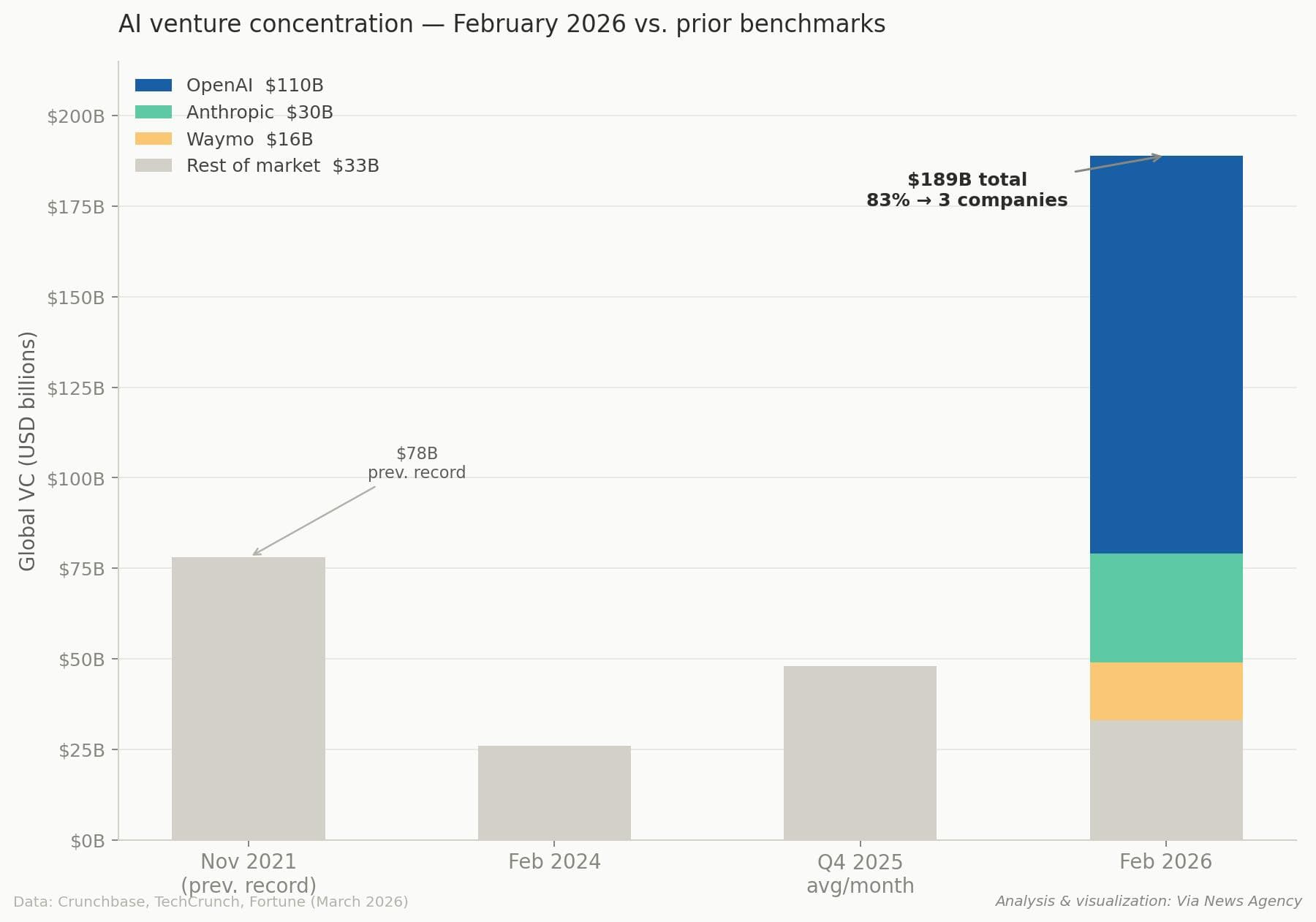
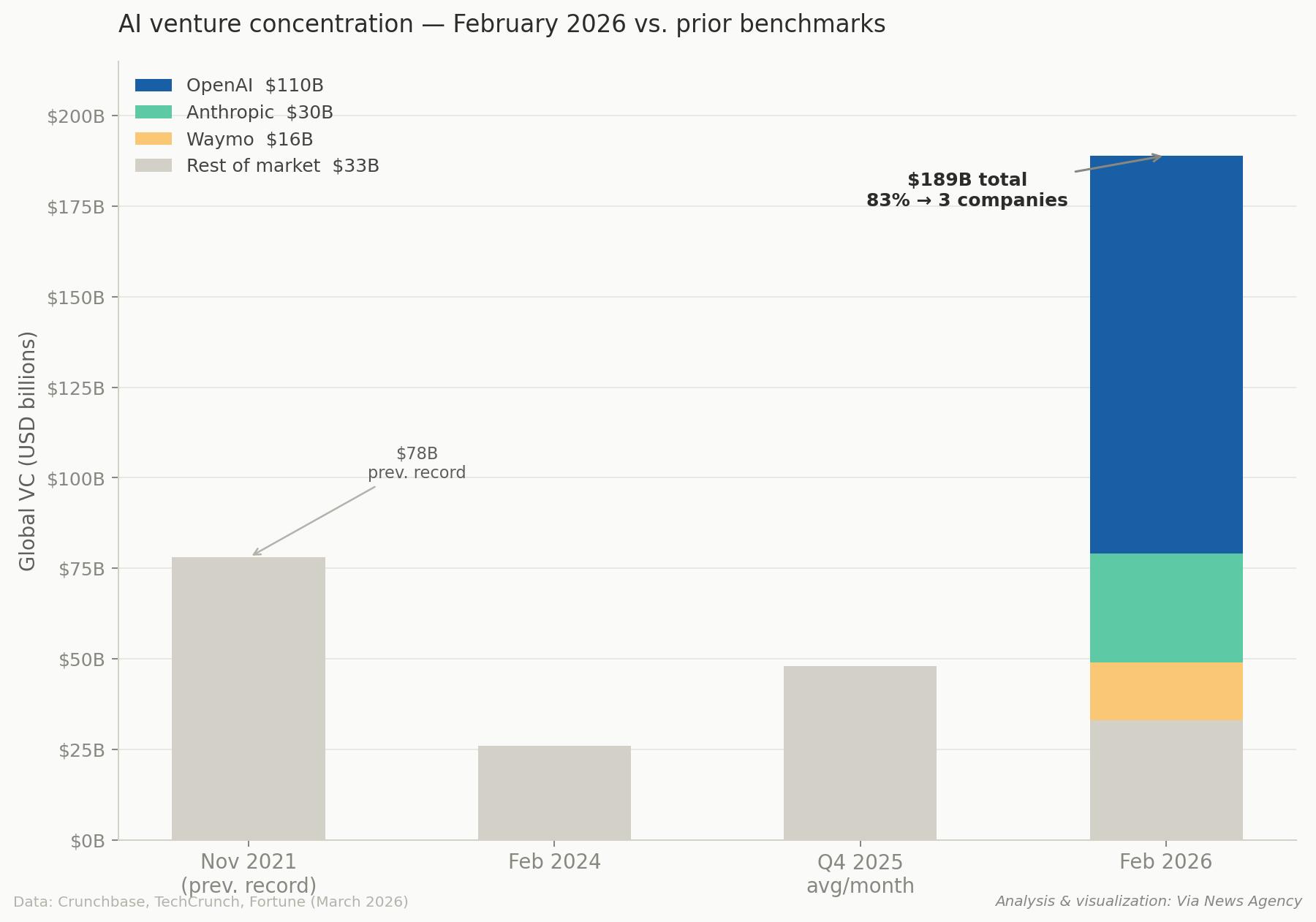
The AI industry just received its largest capital injection in history. In February 2026, three companies — OpenAI, Anthropic, and Waymo — raised a combined $156 billion, representing 83% of all global venture capital deployed that month.
This isn't typical startup funding. It's infrastructure-scale capital for infrastructure-scale ambitions.
The Numbers
- OpenAI: $110B+ — the largest private venture round ever, later expanded to $120B according to recent CFO statements
- Anthropic: $30B — with backers including Accenture partnering to help organizations scale AI deployment
- Waymo: $16B — accelerating autonomous vehicle infrastructure
These aren't application-layer bets. They're foundation-layer investments in compute, models, and physical AI systems.
What This Capital Enables
Compute at Scale
Training frontier AI models requires unprecedented computational resources. A new class of specialized cloud providers — "neoclouds" — is emerging to serve this demand, with NVIDIA, Google, and Oracle taking center stage at infrastructure conferences worldwide.
Longer Research Horizons
Traditional venture capital operates on 5-7 year exit timelines. AI research breakthroughs don't conform to these schedules. The capital flooding into OpenAI and Anthropic allows multi-year research programs that would be impossible under conventional VC constraints.
Vertical Integration
These companies are building everything from custom chips to cloud infrastructure to end-user applications. This vertical integration requires capital intensity that resembles telecommunications or energy more than software startups.
The Competitive Landscape
While OpenAI and Anthropic capture headlines, the broader AI ecosystem is rapidly evolving. Accenture's partnership with Anthropic to help enterprises "secure, scale, and transform" with AI signals that deployment infrastructure is becoming as important as model capabilities.
Meanwhile, the race extends beyond pure AI labs. Microsoft is reportedly weighing legal action over Amazon's $50 billion cloud deal with OpenAI, highlighting how AI infrastructure has become a competitive battlefield among tech giants.
What This Means for AI Progress
This capital concentration has three implications for AI development:
1. Accelerated Capability Development
More compute and longer research runways mean faster iteration on frontier models. The funding gap between leaders and followers will translate into capability gaps.
2. Infrastructure Lock-in
As these companies build proprietary compute infrastructure, switching costs increase. The AI stack is becoming vertically integrated in ways that may limit future competition.
3. Geopolitical Dimensions
Sovereign wealth funds and strategic investors are participating in these rounds not for financial returns alone, but to ensure access to critical AI infrastructure. This is technology statecraft.
The Road Ahead
The question isn't whether this capital will produce results — it's what kind of AI capabilities emerge when three organizations have more R&D resources than most nations' entire technology budgets.
The answer will shape the next decade of technological development.
Sources:
1 Reuters, "OpenAI secures more funding, lifting record round to $120B, CFO says" (March 25, 2026)
2 Business Wire, "Accenture and Anthropic Team to Help Organizations Secure, Scale and Transform with AI" (March 25, 2026)
3 Bloomberg, "Microsoft weighs legal action over $50 billion Amazon-OpenAI cloud deal" (March 18, 2026)
4 TechCrunch, "Neoclouds: new class of specialized cloud providers entering AI infrastructure" (March 25, 2026)
5 Data Center World, "NVIDIA, Google and Oracle Take Center Stage at Data Center World 2026" (March 25, 2026)