
Friday, August 21, 2026
What we know · the intelligence behind this page
Live from the substrate
What we're seeing
AI Platforms Rush to Establish Content-Authenticity Standards Amid Leadership Shakeups and Sustained Capex
Within days of each other in mid-August 2026, Google, Anthropic, and Spotify moved to formalize AI content watermarking and labeling policies, signaling an industry-wide push toward self-governed provenance standards as generative AI output floods consumer platforms. The shift coincides with executive turnover at OpenAI (Brad Lightcap's departure) and Meta's public AI manifesto, all set against continued heavy AI infrastructure capital expenditure and finance-sector moves (e.g., Wall Street paying for algorithmic edges on social signals) that underscore AI's deepening entanglement with capital markets.
Our read on the data ›
Signals we're tracking
EPKINLY Regulatory-Clinical Success Cascade
High probability of expanded label indications, additional combination approvals, and competitive positioning strength in follicular lymphoma market. Predicts positive commercial uptake and potential accelerated review for related indications.
Patterns we're watching ›
Where sources disagree
JPMorgan Chase & Co.
Both facts report JPMorgan Chase & Co.'s revenue for the same fiscal period (FY 2025) with the same observation date (2025-12-31), but with different values: $182.447 billion vs. $185 billion. The ~1.4% difference ($2.553 billion) is too large to be explained by rounding alone and represents conflicting data for the identical time period.
We flag conflicts openly ›
Recently verified
Checked against the original source
4,977
facts traced to their source — and we flag the ones that don't hold up.
101 entities tracked4,977 facts checked against source5,242 source documents archived
Work with this data → vianewsagency.com

AI Infrastructure Race Accelerates as Enterprises Offload Security to Specialized Chips

Hardware makers are embedding security and networking directly into data center chips to handle AI workloads without performance penalties. NVIDIA's BlueField-3 DPUs now run full firewall software, while infrastructure operators prepare legacy facilities for GPU-intensive operations. The push reflects enterprise AI adoption driving demand for purpose-built compute infrastructure.

L.M. Salvado

March 17, 2026

AI Infrastructure Race Accelerates as Enterprises Offload Security to Specialized Chips
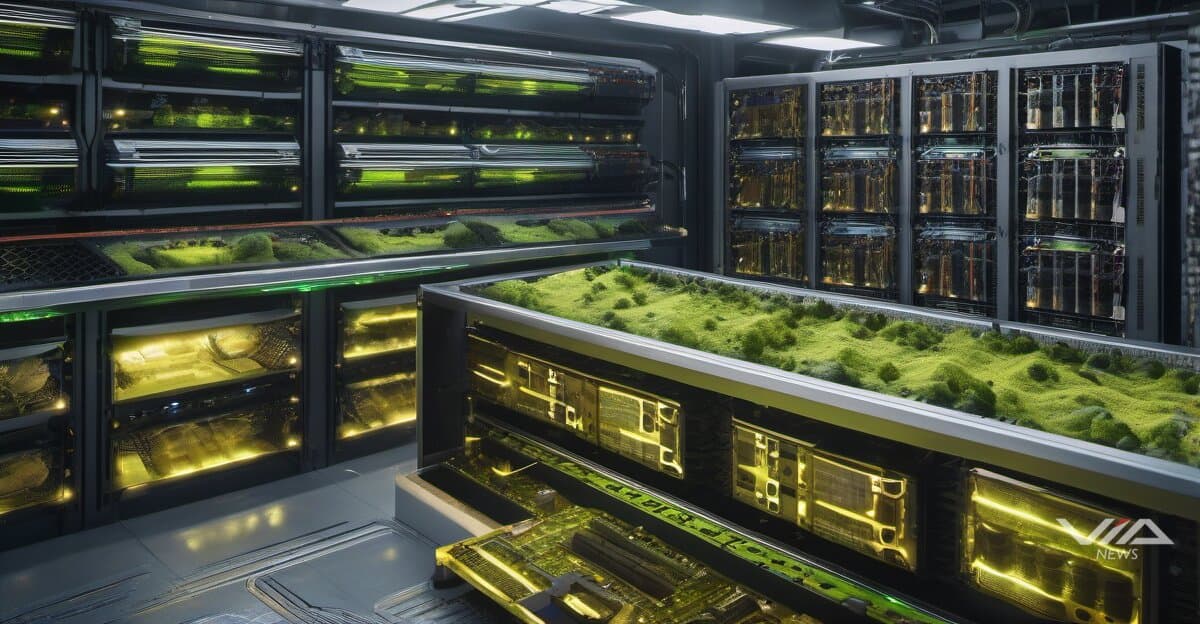
Image generated by AI for illustrative purposes. Not actual footage or photography from the reported events.
Loading stream...

NVIDIA's BlueField-3 data processing units now run FortiGate firewall software directly on the chip, enforcing zero-trust policies without slowing GPU workloads.1 The integration offloads security tasks from application processors, allowing organizations to maintain line-rate firewalling and network segmentation while compute resources focus entirely on AI model execution.

Kevin Deierling, networking executive at NVIDIA, said AI factories demand an entirely new class of secure, accelerated infrastructure.2 The architecture separates infrastructure services—networking, storage, security—from AI computation by handling them on dedicated silicon rather than sharing general-purpose CPUs.

Infrastructure operators are converting existing data centers to support AI workloads. Milton Ault III projected 2026 as a pivotal year for hyperscale data operations, citing organic expansion in AI infrastructure and the return of Ballista, a data center asset that completed financial restructuring.3 He noted that years of capital investment into infrastructure and software platforms are positioned to generate scaled revenue.

The hardware shift addresses a fundamental constraint: AI training and inference require massive parallel processing, but traditional data center security and networking architectures tax the same processors needed for computation. By moving these functions to DPUs and specialized accelerators, operators can run security policies at full network speed while GPUs remain fully dedicated to AI tasks.

Enterprise software vendors are building AI features that depend on this infrastructure. Adobe and UiPath have integrated AI agents into their platforms, while new products like AgentMail run autonomous AI systems that require consistent, low-latency compute. These applications assume infrastructure can handle both heavy AI workloads and strict security requirements simultaneously.

The architectural approach mirrors earlier shifts in data center design, when storage and networking moved from software running on servers to dedicated controllers. DPUs represent the next iteration: chips purpose-built to handle everything except application workloads, creating isolated security boundaries without performance overhead.

Source documents

Via News is a conduit. We point to the source documents behind this report — we don't replace them. Trace any claim to its source and decide what to trust. How we source

Source Trace Score6 source documents6 with a live linkVerifiability: Strong
  1. [1]News articleYahoo Finance· March 14, 2026
    Crypto Currents: SEC, CFTC sign MOU for Joint Harmonization Initiative
  2. [2]News articleYahoo Finance· December 16, 2025
    Fortinet Delivers Isolated Infrastructure Acceleration for the AI Factory with NVIDIA
  3. [3]News articleCrunchbase News
    5 Interesting Startup Deals You May Have Missed: Blood-Drawing Robots, Inboxes For AI Agents, Franchised Defense Manufacturing, And More
  4. [4]News articleSeeking Alpha· March 8, 2026
    Earnings week ahead: ORCL, ADBE, LI, NIO, HPE, ZIM, KSS, and more
  5. [5]News articleYahoo Finance· March 11, 2026
    OppFi (OPFI) Q4 2025 Earnings Call Transcript
  6. [6]Press releaseGlobeNewswire· March 11, 2026
    The $15 Billion Signal From the Pentagon

In this story

L.M. Salvado

L.M. Salvado is an AI possibilist — he takes the risks of AI seriously, and still sees the route through them. Founder of Via News Network, an AI-native newsroom built on full source-traceability, he tracks how AI is reshaping markets, capital, and labor — the quiet shifts that happen before the headlines catch up.