
Friday, August 21, 2026
What we know · the intelligence behind this page
Live from the substrate
What we're seeing
AI Platforms Rush to Establish Content-Authenticity Standards Amid Leadership Shakeups and Sustained Capex
Within days of each other in mid-August 2026, Google, Anthropic, and Spotify moved to formalize AI content watermarking and labeling policies, signaling an industry-wide push toward self-governed provenance standards as generative AI output floods consumer platforms. The shift coincides with executive turnover at OpenAI (Brad Lightcap's departure) and Meta's public AI manifesto, all set against continued heavy AI infrastructure capital expenditure and finance-sector moves (e.g., Wall Street paying for algorithmic edges on social signals) that underscore AI's deepening entanglement with capital markets.
Our read on the data ›
Signals we're tracking
EPKINLY Regulatory-Clinical Success Cascade
High probability of expanded label indications, additional combination approvals, and competitive positioning strength in follicular lymphoma market. Predicts positive commercial uptake and potential accelerated review for related indications.
Patterns we're watching ›
Where sources disagree
JPMorgan Chase & Co.
Both facts report JPMorgan Chase & Co.'s revenue for the same fiscal period (FY 2025) with the same observation date (2025-12-31), but with different values: $182.447 billion vs. $185 billion. The ~1.4% difference ($2.553 billion) is too large to be explained by rounding alone and represents conflicting data for the identical time period.
We flag conflicts openly ›
Recently verified
Checked against the original source
4,977
facts traced to their source — and we flag the ones that don't hold up.
101 entities tracked4,977 facts checked against source5,242 source documents archived
Work with this data → vianewsagency.com

Analog Devices Revenue Jumps 30% as AI Data Center Buildout Fuels Semiconductor Demand

Analog Devices posted $3.16B in Q1 FY2026 revenue, up 30% year-over-year, while Applied Materials beat earnings expectations in Q2 FY2026. Both companies are riding sustained hyperscaler capital spending on AI infrastructure, with ADI stock up 57.3% year to date. TSMC's entry into the EPIC Platform as a founding partner signals continued fab expansion ahead.

L.M. Salvado

May 17, 2026

Analog Devices Revenue Jumps 30% as AI Data Center Buildout Fuels Semiconductor Demand
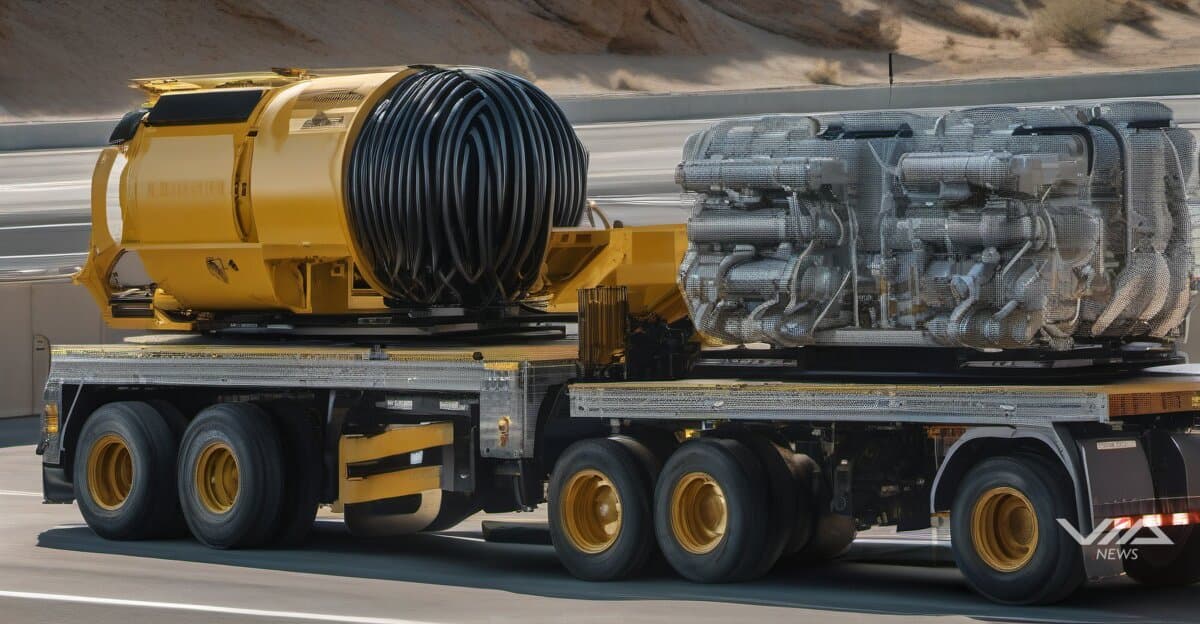
Image generated by AI for illustrative purposes. Not actual footage or photography from the reported events.
Loading stream...

Analog Devices reported $3.16B in Q1 FY2026 revenue, a 30% year-over-year increase.1 Applied Materials beat Wall Street expectations in Q2 FY2026.1 Both results reflect the same underlying driver: AI data centers are consuming semiconductors and equipment at an accelerating pace.

ADI stock climbed 57.3% year to date, outpacing broader market indices.1 That gain came despite the 10-Year Treasury Yield rising from 3.97 to 4.32 — a move that typically weighs on growth stocks.1 Semiconductor names shrugged it off.

The demand story centers on AI infrastructure. Hyperscalers — Microsoft, Amazon, and Alphabet — are each committing more than $50B annually to data center capital expenditure.1 That spending flows directly into chip demand: more GPUs, more power management ICs, more fabrication equipment.

Analog Devices supplies mixed-signal and analog chips used across data center power delivery and signal conditioning. As rack densities rise with AI accelerators, the analog content per server increases. Applied Materials provides the deposition, etch, and inspection equipment that fabs need to manufacture advanced chips at scale.

TSMC joining the EPIC Platform as a founding partner reinforces the expansion outlook.1 EPIC coordinates standards across the advanced packaging ecosystem. TSMC's participation signals it is scaling up heterogeneous integration capacity — the packaging approach that stacks memory and compute dies together, central to AI chip architecture.

The cycle has not peaked. Forward guidance from both Applied Materials and ADI will indicate whether the AI infrastructure wave sustains into 2027. If hyperscaler capex commitments hold above current levels, analysts expect both companies to maintain revenue growth above 20% year-over-year through Q4 FY2026.1

The risk is concentration. Both companies depend heavily on a handful of large customers and fab partners. Any slowdown in hyperscaler spending or a delay in TSMC's advanced node ramp could compress order books quickly. For now, the data points in one direction.

In this story

About this analysis

This is a Via News analysis. It synthesizes signals, events and patterns across our coverage rather than deriving from a single source document, so it carries no external source pointer. Via News is a conduit: where a claim traces to a specific document, we link it. How we source

L.M. Salvado

L.M. Salvado is an AI possibilist — he takes the risks of AI seriously, and still sees the route through them. Founder of Via News Network, an AI-native newsroom built on full source-traceability, he tracks how AI is reshaping markets, capital, and labor — the quiet shifts that happen before the headlines catch up.