
Friday, August 21, 2026
What we know · the intelligence behind this page
Live from the substrate
What we're seeing
AI Platforms Rush to Establish Content-Authenticity Standards Amid Leadership Shakeups and Sustained Capex
Within days of each other in mid-August 2026, Google, Anthropic, and Spotify moved to formalize AI content watermarking and labeling policies, signaling an industry-wide push toward self-governed provenance standards as generative AI output floods consumer platforms. The shift coincides with executive turnover at OpenAI (Brad Lightcap's departure) and Meta's public AI manifesto, all set against continued heavy AI infrastructure capital expenditure and finance-sector moves (e.g., Wall Street paying for algorithmic edges on social signals) that underscore AI's deepening entanglement with capital markets.
Our read on the data ›
Signals we're tracking
EPKINLY Regulatory-Clinical Success Cascade
High probability of expanded label indications, additional combination approvals, and competitive positioning strength in follicular lymphoma market. Predicts positive commercial uptake and potential accelerated review for related indications.
Patterns we're watching ›
Where sources disagree
JPMorgan Chase & Co.
Both facts report JPMorgan Chase & Co.'s revenue for the same fiscal period (FY 2025) with the same observation date (2025-12-31), but with different values: $182.447 billion vs. $185 billion. The ~1.4% difference ($2.553 billion) is too large to be explained by rounding alone and represents conflicting data for the identical time period.
We flag conflicts openly ›
Recently verified
Checked against the original source
4,977
facts traced to their source — and we flag the ones that don't hold up.
101 entities tracked4,977 facts checked against source5,242 source documents archived
Work with this data → vianewsagency.com

Chipmakers Scramble to Build the Backbone of AI: Inside the Supply Chain Arms Race

The semiconductor supply chain is undergoing a structural transformation as chipmakers, packaging specialists, and component providers race to meet surging hyperscaler demand for AI infrastructure. From advanced packaging investments to strategic acquisitions, the industry is signaling a decisive shift from post-COVID recovery toward a new AI-driven growth cycle. Nvidia's upcoming earnings report looms as the sector's most closely watched bellwether.

Chipmakers Scramble to Build the Backbone of AI: Inside the Supply Chain Arms Race
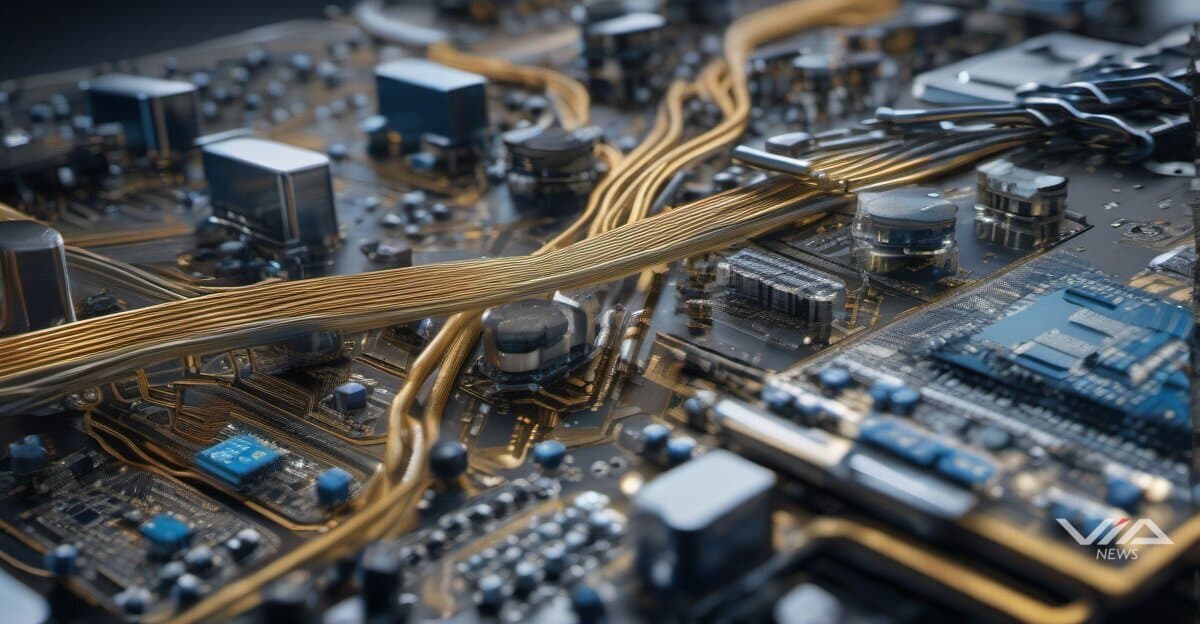
Image generated by AI for illustrative purposes. Not actual footage or photography from the reported events.
Loading stream...

The race to build AI infrastructure is no longer just a story about GPUs. Beneath the headline-grabbing chip announcements lies a sprawling, increasingly strained supply chain — one that every major player from outsourced packaging houses to precision timing specialists is now scrambling to reinforce.

The semiconductor industry entered 2026 navigating a delicate dual reality: a lingering post-COVID inventory correction on one hand, and an accelerating wave of AI-driven capital expenditure on the other. The question for investors and technologists alike is whether the supply chain can scale fast enough to match hyperscaler ambitions — and early signals suggest the answer is a cautious yes.

Packaging Becomes the New Bottleneck

As chip architectures grow more complex — with AI accelerators increasingly relying on chiplet designs, high-bandwidth memory stacking, and heterogeneous integration — advanced packaging has emerged as a critical constraint. Amkor Technology, the world's largest U.S.-headquartered outsourced semiconductor assembly and test (OSAT) provider, is positioning itself at the center of this shift. The company has been investing heavily in advanced packaging infrastructure to service the growing demands of hyperscalers and AI hardware vendors who require capabilities well beyond traditional wire bonding.

Advanced packaging techniques such as fan-out wafer-level packaging, 2.5D interposer integration, and system-in-package (SiP) configurations are now essential for delivering the memory bandwidth and power efficiency that AI workloads require. Capacity in this segment remains tight, and firms like Amkor are locking in long-term design wins to secure their position in an increasingly competitive market.

Consolidation at the Component Level

Further up the stack, precision timing specialist SiTime is making an aggressive move to capture AI infrastructure tailwinds. The company announced its acquisition of Renesas's timing business, a deal expected to be accretive to SiTime's non-GAAP earnings per share within the first year of closing. Timing components — once overlooked as commodity parts — are now mission-critical in AI data centers, where synchronization across thousands of interconnected chips directly impacts system performance and reliability.

The acquisition signals broader consolidation logic: as AI systems scale, the tolerance for timing jitter and clock instability narrows, raising the strategic value of precision timing IP and manufacturing expertise.

Networking and Silicon IP Join the Fray

The supply chain transformation extends to networking silicon. Cisco's recently announced Silicon One G300 reflects a growing industry consensus that AI at scale demands open, standards-based networking infrastructure. As Yousuf Khan of Cisco noted, customers require solutions they can "deploy with confidence across diverse environments" — a direct response to hyperscalers building heterogeneous AI clusters that span multiple chip vendors and network topologies.

Meanwhile, ams OSRAM reported over EUR 500 million in secured design wins for its Digital Light technology, underscoring how optical and sensing components are increasingly woven into the AI hardware ecosystem — from LiDAR-enabled robotics to data center optical interconnects.

The Nvidia Bellwether

All eyes in the semiconductor supply chain are now fixed on Nvidia's imminent earnings report. With an overall sentiment the market characterizes as bullish and improving, the sector's confidence rests heavily on confirmation that AI infrastructure spending is translating into durable, broad-based revenue — not just for GPU makers, but across the entire supply chain stack. A strong Nvidia print would validate margin expansion narratives from OSATs to silicon IP providers and likely accelerate further capacity investment decisions.

The cycle, by most accounts, is transitioning. The correction is fading. The build-out is beginning in earnest.

Source documents

Via News is a conduit. We point to the source documents behind this report — we don't replace them. Trace any claim to its source and decide what to trust. How we source

Source Trace Score12 source documents12 with a live linkVerifiability: Strong
  1. [1]News articleYahoo Finance· February 9, 2026
    Amkor Technology Reports Financial Results for the Fourth Quarter and Full Year 2025
  2. [2]News articleYahoo Finance· February 10, 2026
    ams OSRAM Post Q4 Above Mid-point of Guidance, Delivers EUR 144 m FCF in FY25 and Launches EUR 200 m ‘Simplify’ Transformation and Savings Program
  3. [3]News articleYahoo Finance· February 10, 2026
    Cisco Announces New Silicon One G300, Advanced Systems and Optics to Power and Scale AI Data Centers for the Agentic Era
  4. [4]News articleIEEE Spectrum
    How and When the Memory Chip Shortage Will End
  5. [5]Press releaseGlobeNewswire· February 4, 2026
    SiTime Reports Fourth Quarter and Fiscal Year 2025 Financial Results
  6. [6]News articleYahoo Finance· February 5, 2026
    SiTime to Acquire Renesas’ Timing Business
  7. [7]Press releaseGlobeNewswire· February 4, 2026
    SiTime to Acquire Renesas’ Timing Business
  8. [8]News articleYahoo Finance· February 4, 2026
    Texas Instruments to acquire Silicon Labs
  9. [9]News articleYahoo Finance· November 26, 2025
    AI to Reshape the Global Technology Landscape in 2026, Says TrendForce
  10. [10]News articleSeeking Alpha· February 15, 2026
    Earnings week ahead: WMT, ET. OXY, PANW, NEM, MDT, DVN, DE, ETSY, CVNA, and more
  11. [11]Press releaseGlobeNewswire· February 3, 2026
    Silicon Motion Announces Results for the Fourth Quarter and Year Ended December 31, 2025
  12. [12]News articleYahoo Finance· February 17, 2026
    Stock market today: Dow, S&P 500, Nasdaq end higher in volatile trading day as Apple jumps