
Thursday, September 10, 2026

Nine Enterprise Partnerships at GTC Taipei in 48 Hours Signal Broad AI Hardware Adoption

Adobe, Microsoft, Canonical/Red Hat, Cadence, Siemens, Synopsys, NYSE, CrowdStrike, and Palantir all announced NVIDIA partnerships within a 48-hour window at GTC Taipei. The multi-sector cluster spans creative software, chip design, financial infrastructure, cybersecurity, and enterprise OS. Historical patterns link this type of clustering to NVIDIA data center revenue beats one to two quarters later.

LM Salvado

June 8, 2026

Nine Enterprise Partnerships at GTC Taipei in 48 Hours Signal Broad AI Hardware Adoption
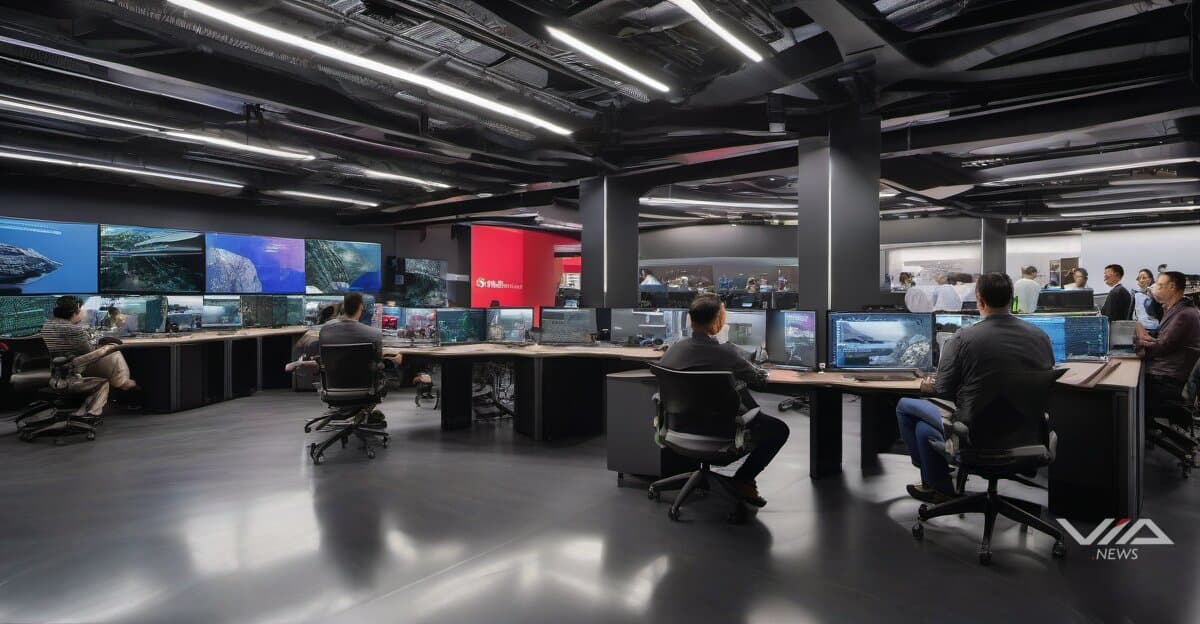
Image generated by AI for illustrative purposes. Not actual footage or photography from the reported events.
Loading stream...

Nine companies announced AI infrastructure partnerships with NVIDIA at GTC Taipei within a 48-hour window, covering creative software, chip design, financial markets, cybersecurity, and enterprise operating systems.1

The partners: Adobe, Microsoft, Canonical, Red Hat, Cadence, Siemens, Synopsys, the New York Stock Exchange, CrowdStrike, and Palantir.1 Simultaneous multi-sector clustering at a single event signals coordinated adoption momentum rather than isolated pilots.

Historical Pattern

Multi-sector partnership clusters at NVIDIA GTC events have historically preceded quarterly revenue beats by one to two quarters.1 The mechanism: enterprise partners convert announced partnerships into hardware orders as internal deployment timelines advance. If the pattern holds, NVIDIA data center revenue acceleration could materialize in Q3 or Q4 2026.1

Vertical Breakdown

EDA vendors Cadence, Siemens, and Synopsys embed AI acceleration into chip design workflows — a segment where compute demand scales with design complexity.1 NYSE brings financial market infrastructure into the AI hardware stack, a sector historically cautious about vendor lock-in. CrowdStrike and Palantir extend adoption into cybersecurity and intelligence workloads.

Microsoft and Canonical/Red Hat anchor cloud and enterprise OS layers, positioning NVIDIA hardware as foundational to mainstream enterprise compute. Adobe ties generative AI to creative production pipelines — the sector closest to end-user deployment at scale.1

Why Breadth Matters

Earlier AI hardware cycles concentrated demand among hyperscalers. That single-sector structure created revenue volatility when large buyers adjusted spend. Multi-vertical adoption restructures that risk profile.1 When chip design, financial markets, cybersecurity, media, and cloud OS adopt simultaneously, no single sector slowdown derails aggregate demand.

GTC Taipei itself reflects NVIDIA's push into Asia-Pacific enterprise markets, where semiconductor manufacturing and AI infrastructure investment intersect. Anchoring a major partnership cluster in Taipei signals direct engagement with regional supply chains, not just Silicon Valley procurement cycles.

For enterprise technology buyers, the 48-hour cluster compresses decision timelines. When tier-one vendors across unrelated verticals commit to the same infrastructure platform simultaneously, it lowers the adoption risk calculus and accelerates internal procurement approvals.

In this story

About this analysis

This is a Via News analysis. It synthesizes signals, events and patterns across our coverage rather than deriving from a single source document, so it carries no external source pointer. Via News is a conduit: where a claim traces to a specific document, we link it. How we source

LM Salvado

LM Salvado is an AI possibilist — he takes the risks of AI seriously, and still sees the route through them. Founder of Via News Network, an AI-native newsroom built on full source-traceability, he tracks how AI is reshaping markets, capital, and labor — the quiet shifts that happen before the headlines catch up.

What we know · the intelligence behind this page
Live from the substrate
What we're seeing
AI Capital Boom Meets Valuation Jitters: Funding Surges While Bellwether Stocks Wobble
A dense wave of AI-sector funding (Socure, Stability AI, Emerald AI, Generalist AI, Gatik, Regent Craft and others closing rounds on the same day) and strong enterprise-automation earnings (UiPath raising full-year guidance) point to continued heavy capital deployment into AI infrastructure, fintech-adjacent AI, and agentic automation. Yet Palantir's stock fell even after winning the Army's high-profile TITAN contract, and commentary (e.g., the Alphabet bull case citing AI capex and regulatory risk) signals growing investor unease about whether current AI valuations and spending levels are sustainable.
Our read on the data ›
Signals we're tracking
Satellite-Terrestrial Network Integration Acceleration
Increased investment and launches in hybrid satellite-cellular networks across telecom industry; competitive responses from other carriers; regulatory activity around satellite spectrum; expansion of emergency/rural connectivity use cases
Patterns we're watching ›
Where sources disagree
JPMorgan Chase & Co.
Both facts represent the same entity (JPMorgan Chase & Co.), same attribute (EPS), and same observation date (2025-12-31), which aligns with FY 2025 year-end reporting. Fact A explicitly states FY 2025 with EPS of 20.02 USD/share. Fact B has an unspecified fiscal period (N/A) but reports 4.63 USD, a significantly different value (4.3x lower). Given identical observation dates and the same metric, both facts appear intended to represent FY 2025 annual EPS. The conflicting values (20.02 vs 4.63) constitute a direct contradiction. The N/A period in Fact B suggests incomplete or corrupted metadata rather than legitimate time-period variation.
We flag conflicts openly ›
Recently verified
Checked against the original source
4,981
facts traced to their source — and we flag the ones that don't hold up.
101 entities tracked4,981 facts checked against source5,278 source documents archived
Query this data → isubstrate.com