
Friday, August 21, 2026
What we know · the intelligence behind this page
Live from the substrate
What we're seeing
AI Platforms Rush to Establish Content-Authenticity Standards Amid Leadership Shakeups and Sustained Capex
Within days of each other in mid-August 2026, Google, Anthropic, and Spotify moved to formalize AI content watermarking and labeling policies, signaling an industry-wide push toward self-governed provenance standards as generative AI output floods consumer platforms. The shift coincides with executive turnover at OpenAI (Brad Lightcap's departure) and Meta's public AI manifesto, all set against continued heavy AI infrastructure capital expenditure and finance-sector moves (e.g., Wall Street paying for algorithmic edges on social signals) that underscore AI's deepening entanglement with capital markets.
Our read on the data ›
Signals we're tracking
EPKINLY Regulatory-Clinical Success Cascade
High probability of expanded label indications, additional combination approvals, and competitive positioning strength in follicular lymphoma market. Predicts positive commercial uptake and potential accelerated review for related indications.
Patterns we're watching ›
Where sources disagree
JPMorgan Chase & Co.
Both facts report JPMorgan Chase & Co.'s revenue for the same fiscal period (FY 2025) with the same observation date (2025-12-31), but with different values: $182.447 billion vs. $185 billion. The ~1.4% difference ($2.553 billion) is too large to be explained by rounding alone and represents conflicting data for the identical time period.
We flag conflicts openly ›
Recently verified
Checked against the original source
4,977
facts traced to their source — and we flag the ones that don't hold up.
101 entities tracked4,977 facts checked against source5,242 source documents archived
Work with this data → vianewsagency.com

Olix Plans 2027 Photonic Chip Launch as AI Semiconductor Market Hits Trillion-Dollar Trajectory

Olix, a photonic semiconductor startup, aims to ship its first AI chip product in 2027 as the industry scales toward Nvidia's projected $1 trillion in chip sales through that year. The timeline positions Olix among emerging specialized chip makers targeting next-generation AI inference workloads beyond traditional GPU architectures.

L.M. Salvado

March 17, 2026

Olix Plans 2027 Photonic Chip Launch as AI Semiconductor Market Hits Trillion-Dollar Trajectory
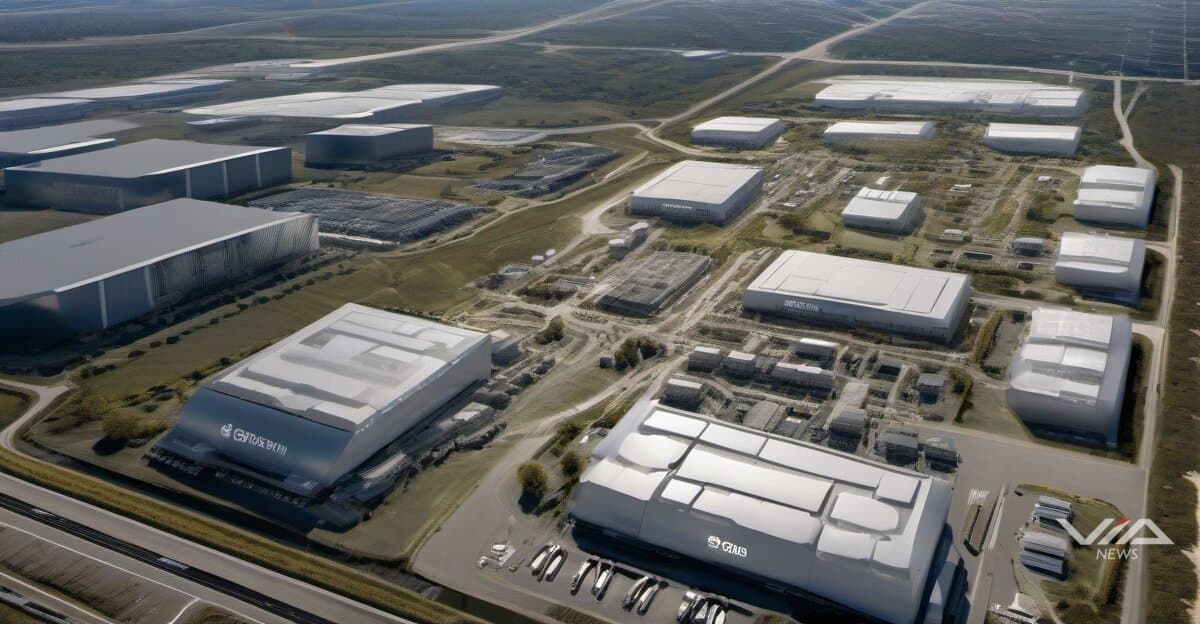
Image generated by AI for illustrative purposes. Not actual footage or photography from the reported events.
Loading stream...

Olix plans to ship its first photonic semiconductor product in 20271, entering a market where Nvidia projects $1 trillion in cumulative chip sales through the same year2. The startup joins companies developing specialized architectures for AI workloads that demand alternatives to power-intensive GPU designs.

Photonic chips use light rather than electricity to transmit data, offering potential advantages in energy efficiency and bandwidth for large-scale AI inference. Olix's 2027 target aligns with production timelines from other specialized chip developers, including Language Processing Unit makers focused on transformer model optimization1.

The semiconductor expansion reflects infrastructure bottlenecks in AI model deployment. Training frontier models now requires tens of thousands of interconnected accelerators, while inference—running deployed models at scale—creates different optimization targets around latency and power consumption per query.

Established players are scaling conventional capacity. Micron is acquiring High-Bandwidth Memory fabrication facilities to supply GPU-adjacent components2, while Meta has committed $12 billion to AI infrastructure partnerships. Amazon's Tranium chips represent cloud providers building custom silicon to reduce dependence on merchant GPU suppliers.

The market bifurcation creates openings for architecture diversity. GPUs dominate training workloads through parallel floating-point operations, but inference workloads may favor chips optimized for specific model types or deployment constraints. Photonic interconnects could address data movement bottlenecks in multi-chip AI systems where inter-processor bandwidth limits scaling.

Olix's 2027 timeline suggests the company is currently in late-stage development or early fabrication partnerships. Semiconductor products typically require 18-24 months from tape-out to volume production, meaning design completion would precede the ship date by roughly two years.

The trillion-dollar forecast encompasses not just AI accelerators but supporting infrastructure: memory, networking silicon, and packaging technologies that enable multi-die integration. This broader value chain explains why companies across the stack—from memory makers to interconnect specialists—are expanding capacity simultaneously.

Source documents

Via News is a conduit. We point to the source documents behind this report — we don't replace them. Trace any claim to its source and decide what to trust. How we source

Source Trace Score3 source documents3 with a live linkVerifiability: Strong
  1. [1]News articleCrunchbase News
    While OpenAI Shattered Records, Robotics and Semiconductor Startups Quietly Added The Most New Unicorns In February
  2. [2]Press releaseGlobeNewswire· March 13, 2026
    D’importants investissements dans l'infrastructure de recherche placent le Canada en tête de l'innovation mondiale
  3. [3]News articleYahoo Finance· March 16, 2026
    Stock market today: Dow, S&P 500, Nasdaq jump to start week, oil slides amid Trump's warning to allies on Iran

In this story

L.M. Salvado

L.M. Salvado is an AI possibilist — he takes the risks of AI seriously, and still sees the route through them. Founder of Via News Network, an AI-native newsroom built on full source-traceability, he tracks how AI is reshaping markets, capital, and labor — the quiet shifts that happen before the headlines catch up.