
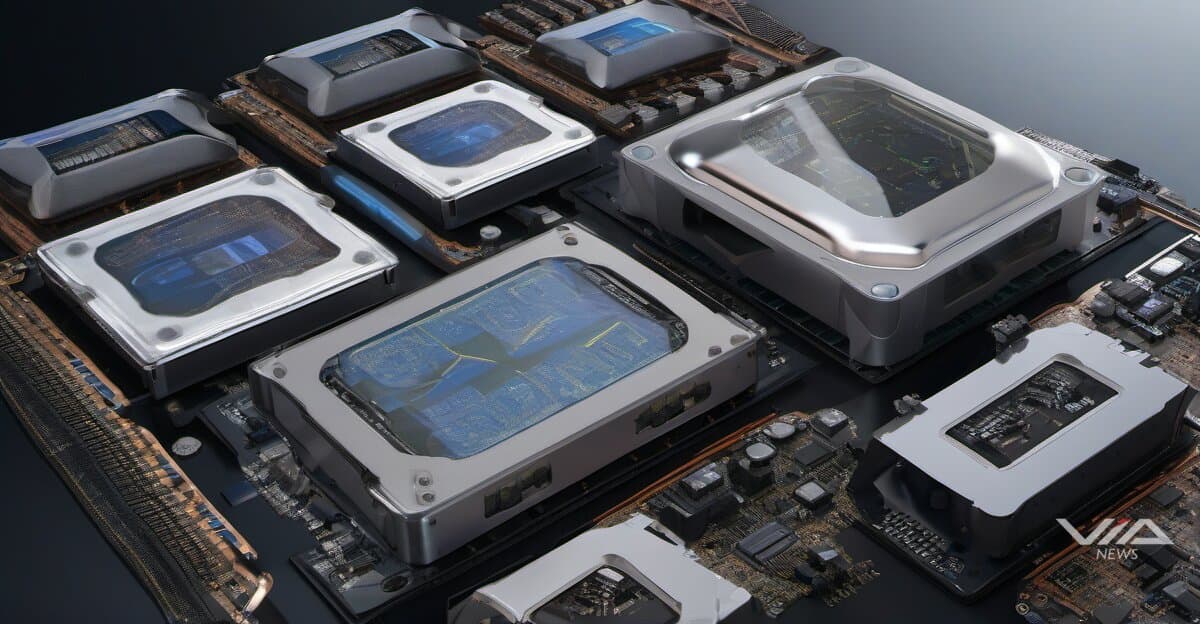
KLA Corp. expects mid-to-high teens revenue growth in advanced packaging equipment through calendar 2026, CEO Michael E. Hurlston told investors. The projection surpasses broader semiconductor equipment industry growth rates and signals how packaging has become a competitive differentiator in AI hardware.
Advanced packaging techniques—which stack multiple chips vertically or arrange them horizontally in dense configurations—solve performance bottlenecks that single-chip designs can't address. AI accelerators require massive memory bandwidth and low-latency chip-to-chip communication, needs that traditional packaging can't meet.
Indium phosphide production capacity increased over 20% in December quarter alone, Hurlston reported. The material enables electro-absorption modulated lasers (EMLs) used in most initial 1.6 terabit-per-second transceivers. These optical interconnects move data between AI chips in data centers, with 200-gigabit lane speeds performing "better than expected," according to Hurlston.
The packaging shift creates new competitive dynamics. Companies like TSMC, Samsung, and Intel invest billions in advanced packaging facilities—CoWoS, X-Cube, and Foveros respectively. Equipment makers who provide the specialized tools for these processes gain leverage. KLA's stock has outperformed the broader semiconductor index, validating investor belief that packaging expertise translates to sustained revenue growth.
Major AI chip designers increasingly rely on packaging innovation rather than just transistor scaling. Nvidia's latest GPUs use CoWoS-L packaging to integrate HBM3E memory. AMD's MI300 series employs 3D chip stacking. These designs demand inspection and metrology equipment that detects defects at nanometer scales across complex multi-layer structures.
The 2026 forecast suggests packaging equipment demand will track AI infrastructure buildout rather than broader chip cycles. Hyperscalers continue data center expansion despite potential cyclical slowdowns in consumer electronics. Advanced packaging revenue as a percentage of total fab spending should rise measurably through 2026, making it a key metric for identifying which equipment suppliers capture AI-driven growth.