
Monday, October 5, 2026

Broadcom Secures $21B in Custom AI Chip Orders as Hyperscalers Race to Build Computational Infrastructure

Broadcom has emerged as a critical AI infrastructure provider, securing over $21 billion in custom XPU and TPU orders from major hyperscalers including a combined $21B from Anthropic and other major cloud providers. The semiconductor giant's transformation signals the massive capital deployment underway as tech companies build out the computational capacity needed for next-generation AI systems.

Broadcom Secures $21B in Custom AI Chip Orders as Hyperscalers Race to Build Computational Infrastructure
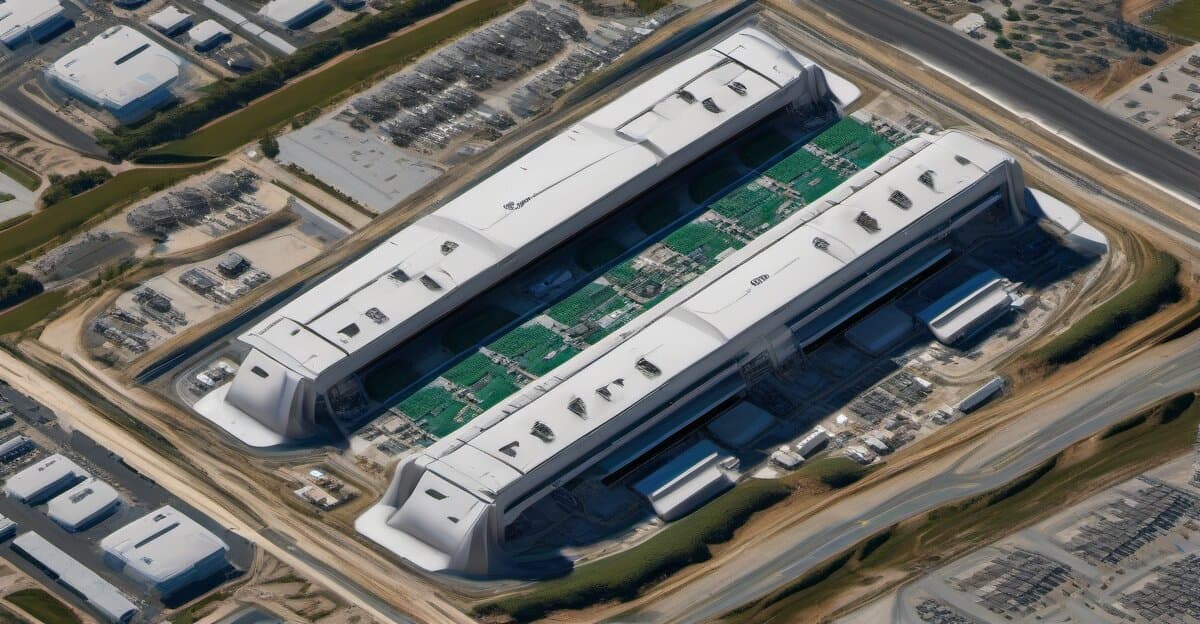
Image generated by AI for illustrative purposes. Not actual footage or photography from the reported events.
Loading stream...

Broadcom is rapidly transforming from a traditional semiconductor and enterprise software company into one of the most critical enablers of AI infrastructure, securing over $21 billion in custom silicon orders that underscore the massive buildout of computational capacity now underway across the hyperscaler ecosystem.

The company has landed major design wins for custom XPUs (accelerated processing units) and TPUs (tensor processing units) from multiple hyperscale cloud providers, including Anthropic, which has committed to $10 billion and an additional $11 billion in orders. A fifth undisclosed customer recently added $1 billion to Broadcom's AI silicon backlog, demonstrating broad-based demand across the industry.

These custom chip orders represent a fundamental shift in how AI infrastructure is being built. Rather than relying solely on off-the-shelf GPUs, hyperscalers are increasingly investing in application-specific integrated circuits (ASICs) optimized for their particular AI workloads. Broadcom's expertise in high-performance networking, custom silicon design, and manufacturing partnerships positions it uniquely to deliver these specialized processors at scale.

The strategic importance of this shift cannot be overstated. Custom silicon allows AI companies to optimize performance-per-watt, reduce costs over time, and gain architectural differentiation in an increasingly competitive landscape. For companies building frontier AI models—which require enormous computational resources—custom chips designed specifically for training and inference workloads can deliver significant advantages over general-purpose accelerators.

Broadcom's momentum extends beyond custom silicon. The company has also partnered with OpenAI on a 10-gigawatt data center initiative, reflecting the staggering power requirements of modern AI infrastructure. To put this in perspective, 10 gigawatts is roughly equivalent to the output of ten large nuclear power plants, highlighting the energy-intensive nature of AI development at scale.

The company's Q1 FY2026 guidance suggests this AI infrastructure boom shows no signs of slowing. As large language models continue to scale and new AI applications emerge across industries, demand for specialized computational hardware is expected to grow exponentially. Broadcom's order book provides visibility into sustained capital deployment from hyperscalers over the coming years.

This transformation marks a significant strategic pivot for Broadcom, which has historically been known for its networking chips and the controversial VMware acquisition. The AI infrastructure opportunity appears to be reshaping the company's growth trajectory and market positioning, with custom silicon and AI-optimized networking becoming core growth drivers.

For the broader AI ecosystem, Broadcom's success illustrates a critical trend: the companies providing picks and shovels for the AI revolution—specialized chips, networking equipment, and data center infrastructure—are capturing enormous value as the industry scales. As AI continues its march toward becoming foundational infrastructure across every sector of the economy, the semiconductor companies enabling this transformation are positioned at the center of one of technology's most significant buildouts.

Source documents

Via News is a conduit. We point to the source documents behind this report — we don't replace them. Trace any claim to its source and decide what to trust. How we source

Source Trace Score3 source documents3 with a live linkVerifiability: High
  1. [1]News articleYahoo Finance· December 12, 2025
    Broadcom (AVGO) Q4 2025 Earnings Call Transcript
  2. [2]Earnings callNasdaq· November 27, 2025
    Datadog (DDOG) Q3 2025 Earnings Call Transcript
  3. [3]News articleYahoo Finance· November 19, 2025
    Stock market today: Dow, S&P 500, Nasdaq rise as stocks pause sell-off streak before Nvidia earnings

In this story

What we know · the intelligence behind this page
Live from the substrate
What we're seeing
Pharma Pipeline Catalysts and M&A Heat Up as AI-Designed Drugs Enter the Clinic
Late-September 2026 brought a dense run of clinical readouts: Novo Nordisk's CagriSema data at EASD, Lilly's ADtouch results for EBGLYSS, and Merck's tulisokibart Phase 2b result. Lilly's $2.9B Merida Biosciences acquisition and the 2026-11-14 FDA PDUFA date for ivonescimab sit alongside these as the main deal and regulatory events. AI-designed drugs such as rentosertib, and speculative AI-linked trial ventures such as QAIAx, are moving from hype toward clinical validation. Broader AI-sector regulatory and legal friction (Tesla Cybercab probe, xAI Minnesota ruling, OpenAI lawsuits) shows rising scrutiny that could spill into AI-driven healthcare.
Our read on the data ›
Signals we're tracking
EPKINLY Regulatory-Clinical Success Cascade
High probability of expanded label indications, additional combination approvals, and competitive positioning strength in follicular lymphoma market. Predicts positive commercial uptake and potential accelerated review for related indications.
Patterns we're watching ›
Where sources disagree
ING Group
Both facts record the same metric (shares_outstanding) for ING Group at the identical observation date (2025-12-31). FACT A states 2,902,437,688 shares; FACT B states 2,902 million shares (2,902,000,000). The difference is 437,688 shares (~0.015%). This is a genuine value conflict, though the discrepancy appears to result from FACT B rounding to the nearest million while FACT A provides the precise count.
We flag conflicts openly ›
Recently verified
✓ Checked against the original source
4,985
facts traced to their source — and we flag the ones that don't hold up.
101 entities tracked4,985 facts checked against source5,340 source documents archived
Query this data → isubstrate.com