
Thursday, September 10, 2026

Hyperscalers Deploy 1 Million Custom AI Chips as Alternative to NVIDIA GPUs

Anthropic agreed to use 1 million AWS Trainium2 chips while Google launched its seventh-generation Ironwood TPU. Amazon's Project Rainier data center and strong Q3 earnings from both Alphabet and Amazon signal custom accelerators gaining market share as hyperscalers optimize AI workload economics.

Hyperscalers Deploy 1 Million Custom AI Chips as Alternative to NVIDIA GPUs
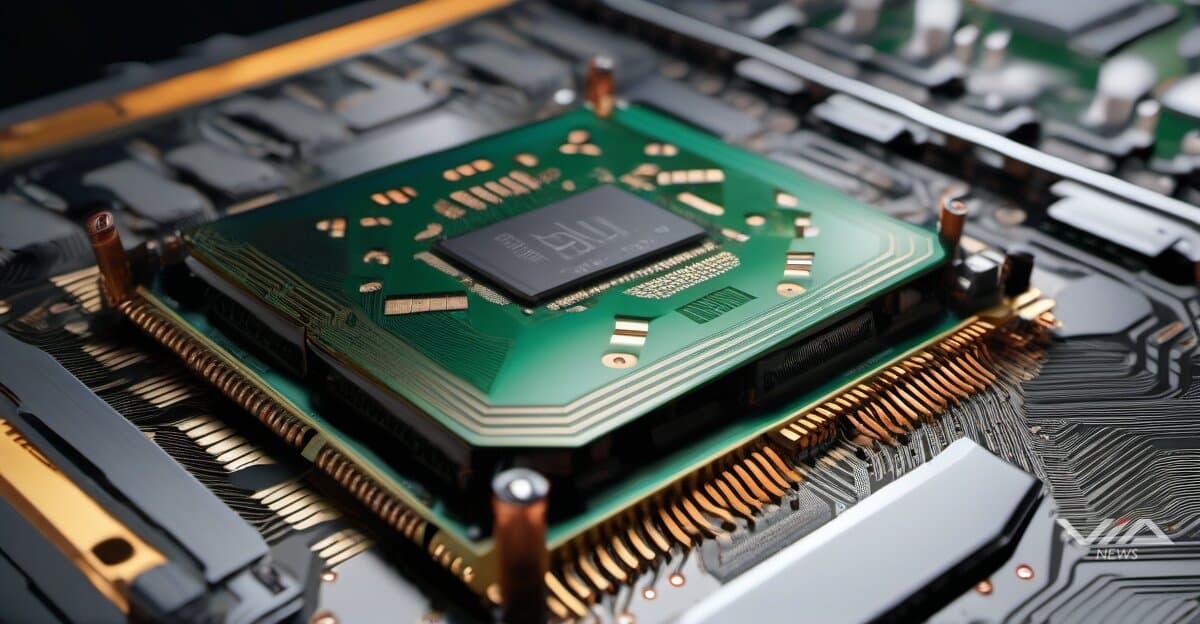
Image generated by AI for illustrative purposes. Not actual footage or photography from the reported events.
Loading stream...

Anthropic committed to deploying 1 million AWS Trainium2 chips in a deal marking the largest custom AI accelerator deployment announced to date. The chips will power Claude AI model training and inference workloads on Amazon's infrastructure.

Google unveiled Ironwood, its seventh-generation TPU, continuing a custom silicon strategy that began in 2016. The company reported strong Q3 2025 earnings partly attributed to AI infrastructure investments. Alphabet's TPU architecture powers Google's Gemini models and cloud AI services.

Amazon revealed Project Rainier, a purpose-built AI data center designed around Trainium chips rather than traditional GPU configurations. The facility represents a shift from retrofitting existing data centers to designing infrastructure optimized for custom accelerators. Amazon's Q3 2025 earnings beat reflected growing AWS AI revenue.

Custom chips offer hyperscalers control over cost-per-inference economics. Training large language models on GPUs costs millions per run. Purpose-built accelerators reduce power consumption and eliminate GPU markup costs. Google reports TPUs deliver better performance-per-watt than comparable GPUs for transformer model training.

NVIDIA dominates AI chip sales with an estimated 90% market share in data center AI accelerators. Custom chips from Amazon, Google, and emerging players like Trainium represent the primary threat to that dominance. Hyperscalers can amortize chip development costs across massive deployments.

The custom accelerator push faces technical barriers. NVIDIA's CUDA software ecosystem took 15 years to mature. Developers familiar with CUDA must learn new frameworks like Amazon's Neuron SDK or Google's XLA compiler. Model portability between cloud providers decreases when training occurs on proprietary chips.

Cost-per-inference metrics will determine whether custom chips capture significant market share in 2026. If Trainium and TPU deployments demonstrate 40-50% cost advantages over GPUs at comparable performance, the economics favor rapid adoption. Early benchmarks suggest custom chips match GPU performance on specific workloads but trail on general-purpose tasks.

In this story

What we know · the intelligence behind this page
Live from the substrate
What we're seeing
AI Capital Boom Meets Valuation Jitters: Funding Surges While Bellwether Stocks Wobble
A dense wave of AI-sector funding (Socure, Stability AI, Emerald AI, Generalist AI, Gatik, Regent Craft and others closing rounds on the same day) and strong enterprise-automation earnings (UiPath raising full-year guidance) point to continued heavy capital deployment into AI infrastructure, fintech-adjacent AI, and agentic automation. Yet Palantir's stock fell even after winning the Army's high-profile TITAN contract, and commentary (e.g., the Alphabet bull case citing AI capex and regulatory risk) signals growing investor unease about whether current AI valuations and spending levels are sustainable.
Our read on the data ›
Signals we're tracking
Satellite-Terrestrial Network Integration Acceleration
Increased investment and launches in hybrid satellite-cellular networks across telecom industry; competitive responses from other carriers; regulatory activity around satellite spectrum; expansion of emergency/rural connectivity use cases
Patterns we're watching ›
Where sources disagree
JPMorgan Chase & Co.
Both facts represent the same entity (JPMorgan Chase & Co.), same attribute (EPS), and same observation date (2025-12-31), which aligns with FY 2025 year-end reporting. Fact A explicitly states FY 2025 with EPS of 20.02 USD/share. Fact B has an unspecified fiscal period (N/A) but reports 4.63 USD, a significantly different value (4.3x lower). Given identical observation dates and the same metric, both facts appear intended to represent FY 2025 annual EPS. The conflicting values (20.02 vs 4.63) constitute a direct contradiction. The N/A period in Fact B suggests incomplete or corrupted metadata rather than legitimate time-period variation.
We flag conflicts openly ›
Recently verified
Checked against the original source
4,981
facts traced to their source — and we flag the ones that don't hold up.
101 entities tracked4,981 facts checked against source5,278 source documents archived
Query this data → isubstrate.com