
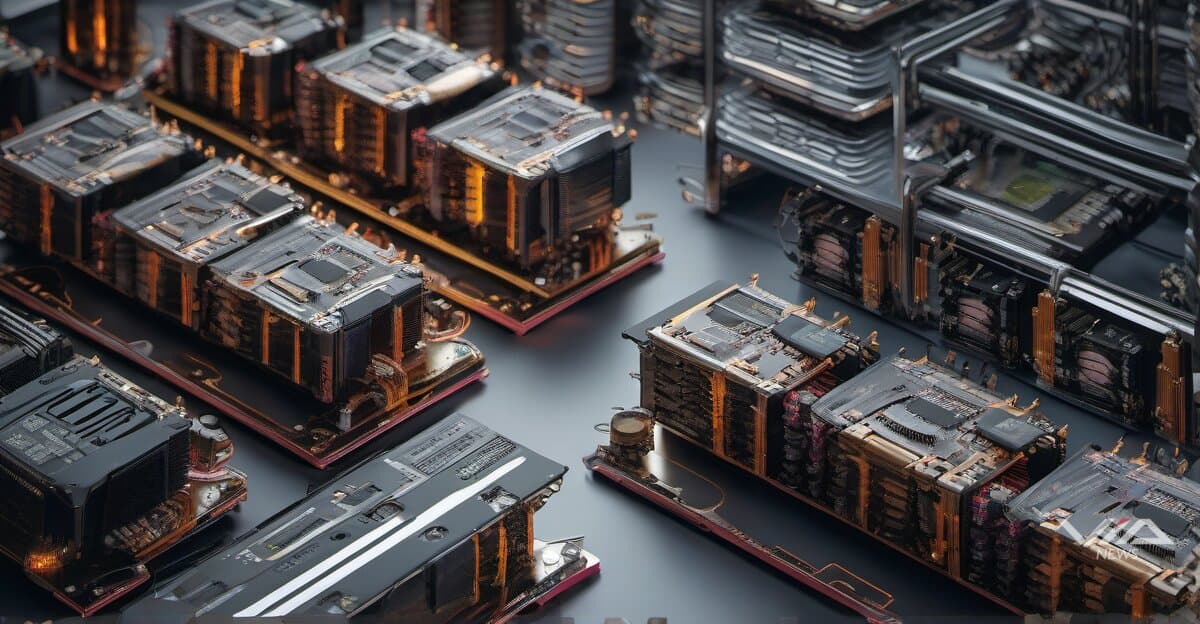
Nvidia has halted production of its H200 GPU chips as US export controls targeting China force a restructuring of the AI hardware supply chain. The move comes as the Trump administration weighs implementing a permitting process for GPU exports, adding regulatory uncertainty to an already constrained market.
The H200, Nvidia's latest high-bandwidth memory GPU, represented a key upgrade path for data centers running large language models. Its discontinuation signals that US semiconductor restrictions are forcing hardware roadmap changes beyond simple export bans. Companies holding H200 inventory now face questions about future compatibility and support cycles.
Export controls have expanded beyond chip sales to include Pentagon supply chain risk designations for AI labs. Several major AI companies are now pursuing defense partnerships while managing regulatory scrutiny over their hardware sourcing and international collaborations. This dual pressure is creating new compliance costs and partnership constraints.
Broadcom posted strong quarterly earnings despite the regulatory turbulence, suggesting traditional networking and infrastructure chips remain insulated from GPU-focused restrictions. The divergence indicates that AI hardware disruption is concentrated in training and inference accelerators rather than broader semiconductor categories.
Neuromorphic computing is gaining attention as an alternative to GPU-based AI infrastructure. These chips mimic brain architecture using spiking neural networks, offering potential power efficiency gains of 100x over conventional processors. Intel's Loihi and IBM's TrueNorth chips have remained research projects, but export restrictions may accelerate commercial development by companies seeking non-GPU architectures exempt from current controls.
The shift raises questions about compatibility. Models trained on Nvidia GPUs don't easily port to neuromorphic hardware, requiring new training approaches and frameworks. However, edge AI applications and robotics may adopt neuromorphic chips faster than data center workloads, creating a bifurcated hardware ecosystem.
Geopolitical tensions are now directly shaping AI architecture choices. China's investments in domestic chip production and alternative computing paradigms are intensifying as US restrictions expand. The result is a fragmenting hardware landscape where regulatory compliance, not just performance, determines technology selection.