
Thursday, September 10, 2026

Nvidia Q4 Earnings on February 25 Will Test $2 Trillion AI Hardware Boom

Nvidia reports Q4 2025 earnings on February 25, 2026, as the primary test of whether datacenter GPU demand sustains through early 2026. Broadcom's positive year-to-date stock performance and Microsoft's Azure growth in Q3 2025 signal continued infrastructure spending. Analysts expect revenue guidance to reveal whether cloud providers maintain accelerated AI hardware purchases.

Nvidia Q4 Earnings on February 25 Will Test $2 Trillion AI Hardware Boom
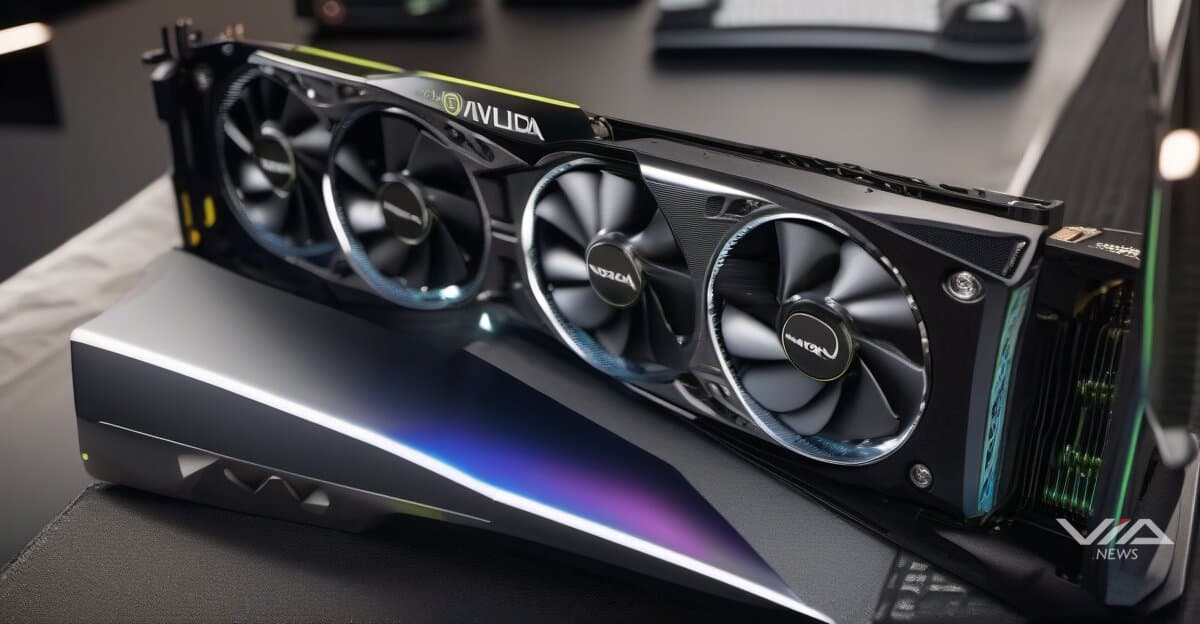
Image generated by AI for illustrative purposes. Not actual footage or photography from the reported events.
Loading stream...

Nvidia reports Q4 2025 earnings on February 25, 2026, providing the first major signal of whether AI hardware demand holds through Q1 2026. The company's datacenter GPU shipments and forward guidance will indicate if hyperscalers sustain the accelerated spending that drove chip stocks higher in 2025.

Broadcom's positive year-to-date stock performance through January 2026 suggests infrastructure demand remains elevated. Microsoft's Azure growth in Q3 2025 (fiscal year 2026 Q1) showed cloud providers expanding capacity. These indicators position Nvidia's earnings as a critical test of whether capital expenditure on AI accelerators continues at 2025 levels.

The GPU market now depends on sustained orders from Microsoft, Amazon, Google, and Meta. These companies drove Nvidia's datacenter revenue to record levels in 2024-2025. Any slowdown in their hardware purchases would signal a shift in AI infrastructure buildout timing.

Intel's Core Ultra Series 3 processors will power over 200 PC designs, expanding AI processing beyond datacenters. Ensurge Micropower develops microbattery technology for AI-enabled edge devices. Both indicate hardware diversification as AI workloads spread from centralized GPUs to endpoint devices.

Analysts will scrutinize three metrics on February 25: datacenter revenue growth rate, Q1 2026 guidance, and GPU allocation to cloud versus enterprise customers. Nvidia's stock trades at valuations that assume continued revenue expansion. Guidance below consensus would pressure semiconductor stocks broadly.

AI accelerator design wins matter beyond Nvidia. AMD competes for datacenter share, while custom chips from Amazon (Trainium), Google (TPU), and Microsoft (Maia) reduce reliance on third-party GPUs. Nvidia's market share trajectory will clarify whether hyperscalers commit to multi-vendor strategies or maintain GPU concentration.

February 25 earnings arrive as AI companies balance infrastructure costs against revenue growth. If Nvidia reports strong demand and raises guidance, it confirms AI hardware spending extends through at least mid-2026. Weak results would suggest the first pause in the GPU boom that began in early 2023.

In this story

What we know · the intelligence behind this page
Live from the substrate
What we're seeing
AI Capital Boom Meets Valuation Jitters: Funding Surges While Bellwether Stocks Wobble
A dense wave of AI-sector funding (Socure, Stability AI, Emerald AI, Generalist AI, Gatik, Regent Craft and others closing rounds on the same day) and strong enterprise-automation earnings (UiPath raising full-year guidance) point to continued heavy capital deployment into AI infrastructure, fintech-adjacent AI, and agentic automation. Yet Palantir's stock fell even after winning the Army's high-profile TITAN contract, and commentary (e.g., the Alphabet bull case citing AI capex and regulatory risk) signals growing investor unease about whether current AI valuations and spending levels are sustainable.
Our read on the data ›
Signals we're tracking
Satellite-Terrestrial Network Integration Acceleration
Increased investment and launches in hybrid satellite-cellular networks across telecom industry; competitive responses from other carriers; regulatory activity around satellite spectrum; expansion of emergency/rural connectivity use cases
Patterns we're watching ›
Where sources disagree
JPMorgan Chase & Co.
Both facts represent the same entity (JPMorgan Chase & Co.), same attribute (EPS), and same observation date (2025-12-31), which aligns with FY 2025 year-end reporting. Fact A explicitly states FY 2025 with EPS of 20.02 USD/share. Fact B has an unspecified fiscal period (N/A) but reports 4.63 USD, a significantly different value (4.3x lower). Given identical observation dates and the same metric, both facts appear intended to represent FY 2025 annual EPS. The conflicting values (20.02 vs 4.63) constitute a direct contradiction. The N/A period in Fact B suggests incomplete or corrupted metadata rather than legitimate time-period variation.
We flag conflicts openly ›
Recently verified
Checked against the original source
4,981
facts traced to their source — and we flag the ones that don't hold up.
101 entities tracked4,981 facts checked against source5,278 source documents archived
Query this data → isubstrate.com