
Friday, August 21, 2026
What we know · the intelligence behind this page
Live from the substrate
What we're seeing
AI Platforms Rush to Establish Content-Authenticity Standards Amid Leadership Shakeups and Sustained Capex
Within days of each other in mid-August 2026, Google, Anthropic, and Spotify moved to formalize AI content watermarking and labeling policies, signaling an industry-wide push toward self-governed provenance standards as generative AI output floods consumer platforms. The shift coincides with executive turnover at OpenAI (Brad Lightcap's departure) and Meta's public AI manifesto, all set against continued heavy AI infrastructure capital expenditure and finance-sector moves (e.g., Wall Street paying for algorithmic edges on social signals) that underscore AI's deepening entanglement with capital markets.
Our read on the data ›
Signals we're tracking
EPKINLY Regulatory-Clinical Success Cascade
High probability of expanded label indications, additional combination approvals, and competitive positioning strength in follicular lymphoma market. Predicts positive commercial uptake and potential accelerated review for related indications.
Patterns we're watching ›
Where sources disagree
JPMorgan Chase & Co.
Both facts report JPMorgan Chase & Co.'s revenue for the same fiscal period (FY 2025) with the same observation date (2025-12-31), but with different values: $182.447 billion vs. $185 billion. The ~1.4% difference ($2.553 billion) is too large to be explained by rounding alone and represents conflicting data for the identical time period.
We flag conflicts openly ›
Recently verified
Checked against the original source
4,977
facts traced to their source — and we flag the ones that don't hold up.
101 entities tracked4,977 facts checked against source5,242 source documents archived
Work with this data → vianewsagency.com

Nvidia's Vera Rubin Architecture Emerges as U.S. Bans Chinese Rare Earth Materials from Defense Chips

The U.S. will ban Chinese rare earth materials from defense systems starting 2027, forcing semiconductor supply chain restructuring. Nvidia is advancing its Vera Rubin architecture while Intel joins SpaceX and Tesla in the Terafab project targeting 1 terawatt per year of compute production. The shift affects defense contractors, automotive suppliers, and AI infrastructure providers.

L.M. Salvado

April 24, 2026

Nvidia's Vera Rubin Architecture Emerges as U.S. Bans Chinese Rare Earth Materials from Defense Chips
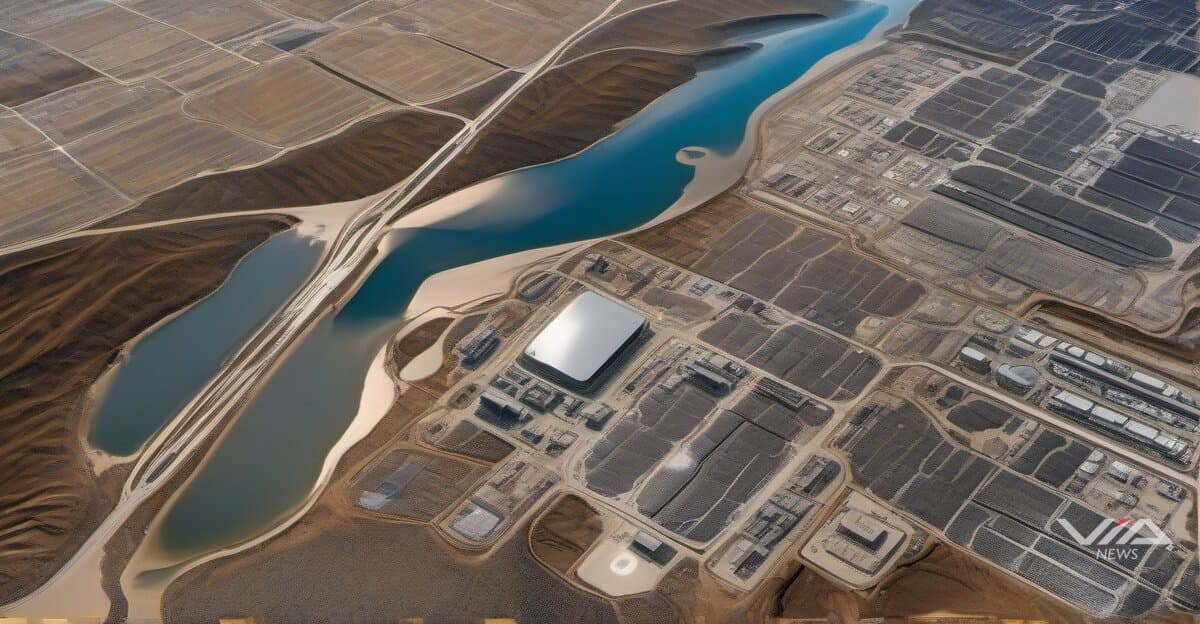
Image generated by AI for illustrative purposes. Not actual footage or photography from the reported events.
Loading stream...

The U.S. government will ban Chinese rare earth materials from defense systems beginning in 2027, triggering a supply chain realignment across the semiconductor industry. The regulatory action comes as chipmakers accelerate next-generation AI hardware development, with Nvidia's Vera Rubin architecture representing the latest advancement in AI-focused chip design.

Intel announced its participation in the Terafab project alongside SpaceX, xAI, and Tesla to "refactor silicon fab technology" with a goal of producing 1 terawatt per year of compute capacity.1 The collaboration leverages Intel's capabilities to "design, fabricate, and package ultra-high-performance chips at scale," according to the company's statement.1

The defense materials ban intersects with major leadership transitions and strategic pivots. Tim Cook is stepping down from Apple's CEO role, while Panasonic Automotive is rebranding to Mobitera, signaling broader industry restructuring. Camtek is developing AI packaging solutions as demand grows for specialized chip assembly techniques required by advanced architectures like Vera Rubin.

Semiconductor companies are adjusting to the new landscape. POET Technologies clarified that U.S. shareholders making a Qualified Electing Fund election for fiscal year 2025 "are not expected to have current income inclusions" under PFIC rules.2 Silicon Motion noted its customers "include most of the NAND flash vendors, storage device module makers and leading OEMs," highlighting supply chain interconnections.3

LG Innotek is developing physical AI capabilities, with its virtual sensor partnership expected to generate orders from global carmakers.4 The automotive sector represents a growing application area for AI-accelerated chips as vehicle computing requirements expand.

The rare earth materials ban affects magnets, motors, and other components critical to defense electronics. Manufacturers must establish alternative supply chains within three years, accelerating domestic and allied-nation sourcing initiatives. This timeline aligns with next-generation product launches, creating pressure to validate new architectures like Vera Rubin with non-Chinese materials.

The transformation spans defense technology, automotive suppliers, and AI infrastructure providers, with implications for companies dependent on Chinese rare earth processing. China controls approximately 70% of global rare earth mining and 90% of processing capacity, making supply chain diversification technically challenging and capital-intensive.

Source documents

Via News is a conduit. We point to the source documents behind this report — we don't replace them. Trace any claim to its source and decide what to trust. How we source

Source Trace Score12 source documents12 with a live linkVerifiability: Strong
  1. [1]News articleYahoo Finance· March 29, 2026
    Applied Intuition and LG Innotek Enter Strategic Partnership to Advance Autonomous Vehicle Development
  2. [2]News articleYahoo Finance· April 3, 2026
    Camtek’s US$31m AI Packaging Order Puts OSAT Exposure In Focus
  3. [3]News articleNasdaq· April 12, 2026
    Here's the Real Reason SpaceX Is Teaming Up With Intel on Terafab
  4. [4]News articleThe Verge AI
    Intel will help build Elon Musk’s Terafab AI chip factory
  5. [5]News articleYahoo Finance· March 29, 2026
    LG Innotek Accelerates Physical AI Market Entry Through Partnership with Applied Intuition
  6. [6]Press releaseGlobeNewswire· April 13, 2026
    Navitas Semiconductor Appoints Gregory M. Fischer as Independent Director to its Board
  7. [7]Press releaseGlobeNewswire· April 20, 2026
    NXP Announces Redemption of 3.875% Senior Notes Due 2026
  8. [8]Press releaseGlobeNewswire· April 14, 2026
    POET Technologies Provides Clarity on its Passive Foreign Investment Company (PFIC) Status
  9. [9]Press releaseGlobeNewswire· April 10, 2026
    Silicon Motion Announces First Quarter 2026 Earnings Conference Call
  10. [10]News articleYahoo Finance· March 19, 2026
    A New U.S. Facility Could Break China’s Grip on Critical Materials
  11. [11]News articleYahoo Finance· April 21, 2026
    Apple is going to miss Tim Cook — one statistic perfectly illustrates why
  12. [12]News articleYahoo Finance· March 25, 2026
    Here's How Micron Technology, Nvidia, and AMD Could Help This Unstoppable ETF Turn $250,000 Into $1 Million in 10 Years

In this story

L.M. Salvado

L.M. Salvado is an AI possibilist — he takes the risks of AI seriously, and still sees the route through them. Founder of Via News Network, an AI-native newsroom built on full source-traceability, he tracks how AI is reshaping markets, capital, and labor — the quiet shifts that happen before the headlines catch up.