
Thursday, September 10, 2026

NYSE Rebuilds Market Infrastructure on NVIDIA Vera CPU and BlueField-4 STX

NYSE is partnering with NVIDIA, HPE, and streaming platform Redpanda to rebuild its market infrastructure on AI-optimized silicon, including NVIDIA's Vera CPU and BlueField-4 STX data processing units. Financial exchanges are expected to accelerate AI-native infrastructure spending in H2 2026. Legacy market data vendors including Broadridge, SS&C, and FIS face competitive pressure as exchanges internalize more of their own infrastructure.

LM Salvado

June 7, 2026

NYSE Rebuilds Market Infrastructure on NVIDIA Vera CPU and BlueField-4 STX
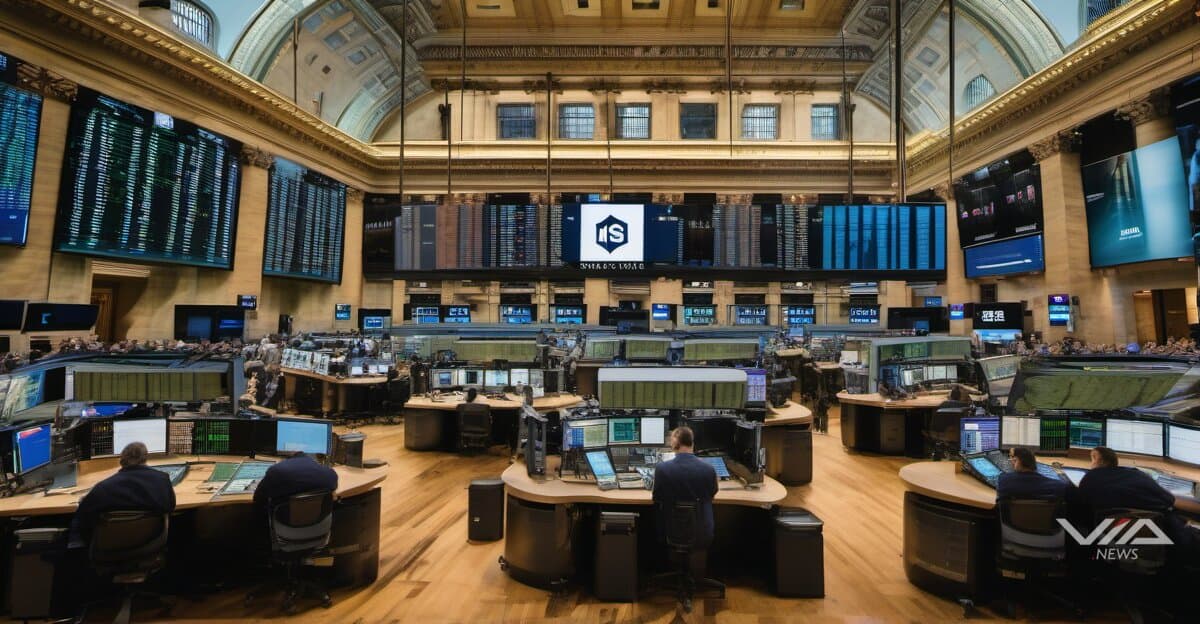
Image generated by AI for illustrative purposes. Not actual footage or photography from the reported events.
Loading stream...

NYSE is rebuilding its market infrastructure on NVIDIA's Vera CPU and BlueField-4 STX networking chips, partnering with HPE and streaming platform Redpanda.1

Redpanda, a Kafka-compatible data platform engineered for financial pipelines, handles the high-throughput streaming layer.1 The combination targets latency-sensitive exchange workloads where microseconds determine execution quality.

BlueField-4 STX is NVIDIA's latest data processing unit, designed to offload networking, storage, and security tasks from general-purpose CPUs. Vera is NVIDIA's ARM-based CPU, the compute backbone for its next-generation data center stack. Together they form a unified AI-native platform — purpose-built rather than adapted from commodity x86 servers.

For NYSE, the overhaul positions the exchange to run AI-driven market surveillance, real-time risk analytics, and intelligent order routing at the hardware layer. Traditional exchange infrastructure depended on commodity server farms and off-the-shelf networking gear. NVIDIA's silicon stack shifts that model toward tight integration between compute and networking.

HPE supplies the server and storage infrastructure in the deployment. Redpanda replaces legacy message-queue systems, offering financial-grade throughput with exactly-once delivery semantics — a requirement for regulated market data pipelines.

Financial exchanges are projected to accelerate capital spending on AI-native infrastructure in H2 2026.1 NVIDIA's data center segment benefits directly from this cycle. Legacy market data vendors — Broadridge, SS&C, and FIS — face growing competitive pressure as exchanges pull more infrastructure capabilities in-house.1

Exchanges are among the most demanding compute environments: deterministic latency, continuous uptime, and regulatory audit trails are non-negotiable. The NYSE deployment signals that AI hardware is expanding beyond cloud model training into regulated financial infrastructure.

NVIDIA's strategy has long centered on bundling CPU, GPU, and DPU into unified enterprise platforms. The NYSE deal extends that approach into capital markets, a sector with long infrastructure replacement cycles and deep vendor dependencies.

If major exchanges replicate NYSE's model, the cumulative CapEx impact could be significant. Global equity exchanges, futures markets, and clearinghouses share the same aging infrastructure stacks — and the same latency imperatives that AI-native silicon is designed to solve.

In this story

About this analysis

This is a Via News analysis. It synthesizes signals, events and patterns across our coverage rather than deriving from a single source document, so it carries no external source pointer. Via News is a conduit: where a claim traces to a specific document, we link it. How we source

LM Salvado

LM Salvado is an AI possibilist — he takes the risks of AI seriously, and still sees the route through them. Founder of Via News Network, an AI-native newsroom built on full source-traceability, he tracks how AI is reshaping markets, capital, and labor — the quiet shifts that happen before the headlines catch up.

What we know · the intelligence behind this page
Live from the substrate
What we're seeing
AI Capital Boom Meets Valuation Jitters: Funding Surges While Bellwether Stocks Wobble
A dense wave of AI-sector funding (Socure, Stability AI, Emerald AI, Generalist AI, Gatik, Regent Craft and others closing rounds on the same day) and strong enterprise-automation earnings (UiPath raising full-year guidance) point to continued heavy capital deployment into AI infrastructure, fintech-adjacent AI, and agentic automation. Yet Palantir's stock fell even after winning the Army's high-profile TITAN contract, and commentary (e.g., the Alphabet bull case citing AI capex and regulatory risk) signals growing investor unease about whether current AI valuations and spending levels are sustainable.
Our read on the data ›
Signals we're tracking
Satellite-Terrestrial Network Integration Acceleration
Increased investment and launches in hybrid satellite-cellular networks across telecom industry; competitive responses from other carriers; regulatory activity around satellite spectrum; expansion of emergency/rural connectivity use cases
Patterns we're watching ›
Where sources disagree
JPMorgan Chase & Co.
Both facts represent the same entity (JPMorgan Chase & Co.), same attribute (EPS), and same observation date (2025-12-31), which aligns with FY 2025 year-end reporting. Fact A explicitly states FY 2025 with EPS of 20.02 USD/share. Fact B has an unspecified fiscal period (N/A) but reports 4.63 USD, a significantly different value (4.3x lower). Given identical observation dates and the same metric, both facts appear intended to represent FY 2025 annual EPS. The conflicting values (20.02 vs 4.63) constitute a direct contradiction. The N/A period in Fact B suggests incomplete or corrupted metadata rather than legitimate time-period variation.
We flag conflicts openly ›
Recently verified
Checked against the original source
4,981
facts traced to their source — and we flag the ones that don't hold up.
101 entities tracked4,981 facts checked against source5,278 source documents archived
Query this data → isubstrate.com