
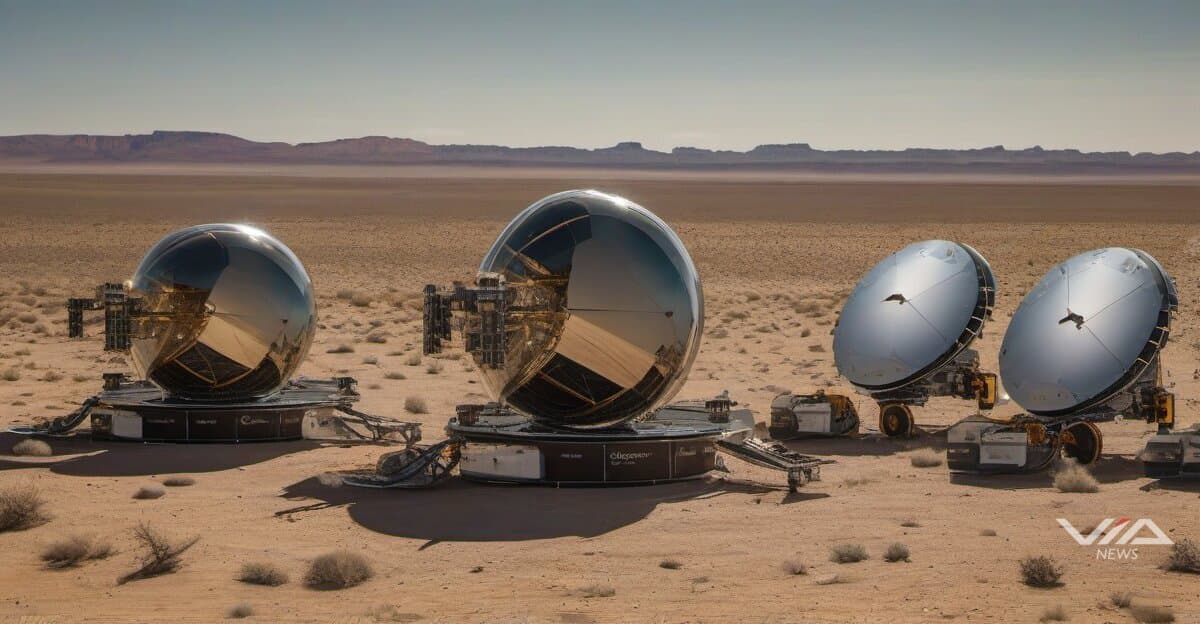
Planet Labs is preparing to bring artificial intelligence compute directly into space. The Earth observation company announced plans to deploy two prototype satellites under its Project SunCatcher initiative in early 2027, with each satellite carrying Google Tensor Processing Units (TPUs) designed to run AI workloads on-orbit rather than relaying raw data to ground stations for processing.
The development was disclosed during Planet Labs' Q3 2026 earnings call on December 10, 2025, where CEO Will Marshall outlined a pipeline of next-generation satellite programs. SunCatcher is being developed with direct R&D funding and technical collaboration from Google, including involvement from the Gemini team, underscoring the scale of ambition behind the project.
Why On-Orbit AI Processing Matters
Traditional Earth observation satellites capture imagery and transmit it to the ground, where analysts and algorithms process the data after the fact. That model introduces latency — sometimes hours — between an event occurring and actionable intelligence reaching a customer. For defense, disaster response, and maritime monitoring use cases, that delay has real operational costs.
By embedding Google TPUs directly into the satellite bus, SunCatcher is designed to run inference models while still in orbit. A satellite passing over a flood zone, for instance, could identify affected areas and prioritize which image tiles to downlink, rather than transmitting everything and sorting it later. The same principle applies to detecting vessels of interest, monitoring wildfires, or flagging changes in agricultural land use.
This class of capability — known as edge AI — has become a priority across industries where bandwidth or latency constraints make cloud-centric processing impractical. Space is perhaps the most extreme version of that constraint: downlink windows are limited, ground station access is not always guaranteed, and the volume of imagery from a large constellation can quickly overwhelm transmission capacity.
Google's Strategic Bet on Space AI Infrastructure
Google's involvement goes beyond hardware supply. The company is funding the SunCatcher R&D program directly and has embedded its Gemini team in the collaboration, suggesting that the TPU deployment is tied to broader work on running large language and vision models in resource-constrained environments. For Google, SunCatcher represents a testbed for TPU performance outside the controlled conditions of a data center — a meaningful validation step for edge deployments more broadly.
Planet Labs is also deploying NVIDIA GPUs on its separate Owl constellation, a 1-meter class monitoring fleet with the first tech demonstration targeted for late 2026. The parallel use of both Google TPUs and NVIDIA GPUs across different satellite programs reflects a pragmatic, multi-vendor approach to on-orbit compute — and highlights how quickly the space hardware ecosystem is aligning with the same silicon choices driving AI on the ground.
Financial Momentum Behind the Vision
The SunCatcher announcement comes as Planet Labs reports strengthening financials. Q3 2026 revenue reached $81.3 million, up 33% year-over-year, with an adjusted EBITDA profit of $5.6 million — the fourth consecutive positive quarter. The company's backlog surged 216% year-over-year to $734.5 million, driven largely by defense and intelligence contracts, which grew 70% year-over-year. The company raised $460 million in convertible notes at 0.5% interest to fund its constellation expansion.
That capital base is what makes multi-year hardware bets like SunCatcher viable. Deploying experimental AI compute satellites requires upfront investment in design, manufacturing, launch, and ground software — costs that only make sense against a substantial and growing revenue foundation.
The two SunCatcher prototypes are not yet a commercial product. They are proof-of-concept vehicles intended to demonstrate that TPU-based on-orbit inference is technically feasible and economically practical at scale. If the 2027 deployment succeeds, it could accelerate a broader industry shift toward satellites that don't just observe the world — but understand it, in real time, before the data ever touches the ground.