
Thursday, September 10, 2026

TSMC Raises 2026 Capex as AI Chip Demand Triggers $10B+ Semiconductor Facility Buildout

Taiwan Semiconductor increased capital expenditure guidance for 2026, joining Intel and Infineon in a wave of manufacturing expansion driven by AI chip demand. Marvell's December talks to acquire optical interconnect specialist Celestial AI signal a parallel race to solve data bottlenecks in AI training clusters. The investments reflect semiconductor makers betting $10B+ on sustained growth in AI hardware through 2027.

TSMC Raises 2026 Capex as AI Chip Demand Triggers $10B+ Semiconductor Facility Buildout
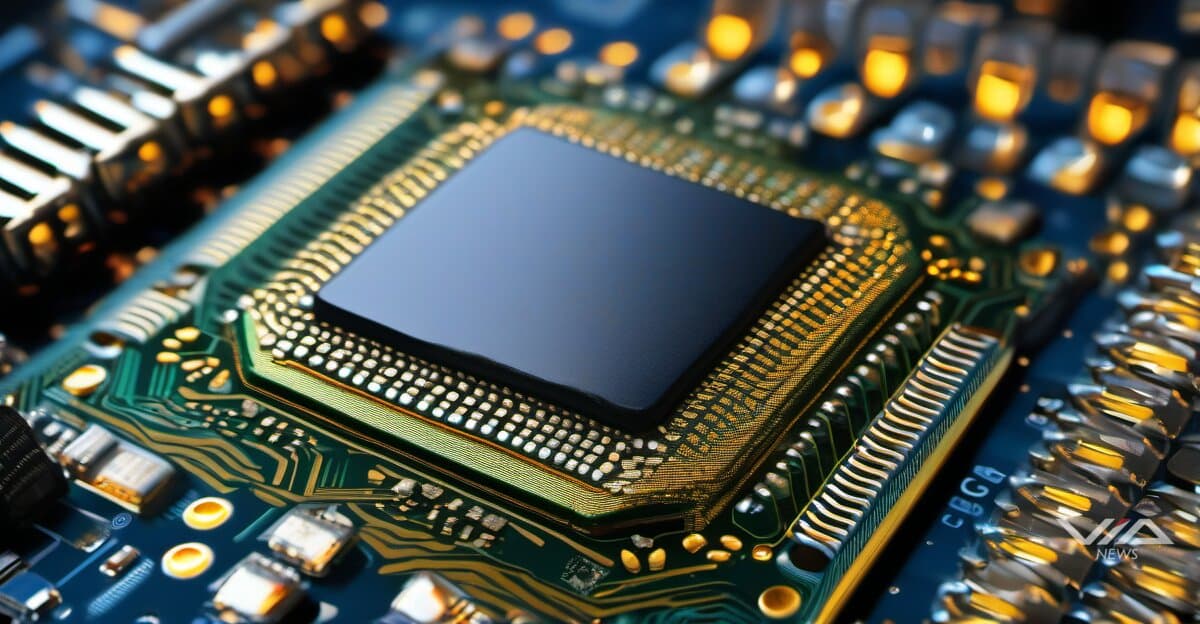
Image generated by AI for illustrative purposes. Not actual footage or photography from the reported events.
Loading stream...

Taiwan Semiconductor Manufacturing Company raised its 2026 capital expenditure guidance on January 1, extending a broader semiconductor buildout triggered by AI chip demand. The move follows Intel's December 2024 Malaysia investment and Infineon Technologies' Dresden facility expansion, where construction is underway with production targets set for late 2026.

The capex increases come as chip designers pursue specialized AI connectivity infrastructure. Marvell Technology entered acquisition talks with Celestial AI in December 2024, targeting the startup's optical interconnect technology. These photonics-based chips move data between GPUs in training clusters, addressing bandwidth constraints that slow large language model development.

Infineon confirmed final funding approval for its Dresden site, which will manufacture power semiconductors for AI data center cooling systems. Microchip Technology reported "broad-based recovery" across end markets in its revised guidance, citing AI infrastructure as a primary growth driver alongside automotive and industrial segments.

The coordinated expansion suggests chip manufacturers expect AI hardware demand to persist through 2027. TSMC's guidance increase specifically targets advanced node capacity for 3nm and 2nm chips used in Nvidia's Blackwell and future Rubin GPU architectures. Intel's Malaysia facility will produce packaging substrates for AI accelerators, a component facing supply shortages since mid-2024.

Optical interconnect acquisitions like Marvell-Celestial AI reflect a strategic shift toward solving data movement problems rather than pure compute power. Current copper-based chip-to-chip links hit physics limits at 800 Gbps, while training GPT-5-scale models requires 1.6 Tbps interconnects. Celestial AI's optical technology promises 10 Tbps bandwidth using silicon photonics.

The semiconductor M&A and capex pattern creates a testable market hypothesis: AI chip revenue growth should correlate with optical computing acquisitions through 2026. TSMC, Intel, and Infineon spending patterns will indicate whether manufacturers see AI demand as cyclical or structural. Early signals point to structural bets—Infineon's Dresden timeline extends to 2028, suggesting confidence beyond near-term AI hype cycles.

In this story

What we know · the intelligence behind this page
Live from the substrate
What we're seeing
AI Capital Boom Meets Valuation Jitters: Funding Surges While Bellwether Stocks Wobble
A dense wave of AI-sector funding (Socure, Stability AI, Emerald AI, Generalist AI, Gatik, Regent Craft and others closing rounds on the same day) and strong enterprise-automation earnings (UiPath raising full-year guidance) point to continued heavy capital deployment into AI infrastructure, fintech-adjacent AI, and agentic automation. Yet Palantir's stock fell even after winning the Army's high-profile TITAN contract, and commentary (e.g., the Alphabet bull case citing AI capex and regulatory risk) signals growing investor unease about whether current AI valuations and spending levels are sustainable.
Our read on the data ›
Signals we're tracking
Satellite-Terrestrial Network Integration Acceleration
Increased investment and launches in hybrid satellite-cellular networks across telecom industry; competitive responses from other carriers; regulatory activity around satellite spectrum; expansion of emergency/rural connectivity use cases
Patterns we're watching ›
Where sources disagree
JPMorgan Chase & Co.
Both facts represent the same entity (JPMorgan Chase & Co.), same attribute (EPS), and same observation date (2025-12-31), which aligns with FY 2025 year-end reporting. Fact A explicitly states FY 2025 with EPS of 20.02 USD/share. Fact B has an unspecified fiscal period (N/A) but reports 4.63 USD, a significantly different value (4.3x lower). Given identical observation dates and the same metric, both facts appear intended to represent FY 2025 annual EPS. The conflicting values (20.02 vs 4.63) constitute a direct contradiction. The N/A period in Fact B suggests incomplete or corrupted metadata rather than legitimate time-period variation.
We flag conflicts openly ›
Recently verified
Checked against the original source
4,981
facts traced to their source — and we flag the ones that don't hold up.
101 entities tracked4,981 facts checked against source5,278 source documents archived
Query this data → isubstrate.com