
Friday, August 21, 2026
What we know · the intelligence behind this page
Live from the substrate
What we're seeing
AI Platforms Rush to Establish Content-Authenticity Standards Amid Leadership Shakeups and Sustained Capex
Within days of each other in mid-August 2026, Google, Anthropic, and Spotify moved to formalize AI content watermarking and labeling policies, signaling an industry-wide push toward self-governed provenance standards as generative AI output floods consumer platforms. The shift coincides with executive turnover at OpenAI (Brad Lightcap's departure) and Meta's public AI manifesto, all set against continued heavy AI infrastructure capital expenditure and finance-sector moves (e.g., Wall Street paying for algorithmic edges on social signals) that underscore AI's deepening entanglement with capital markets.
Our read on the data ›
Signals we're tracking
EPKINLY Regulatory-Clinical Success Cascade
High probability of expanded label indications, additional combination approvals, and competitive positioning strength in follicular lymphoma market. Predicts positive commercial uptake and potential accelerated review for related indications.
Patterns we're watching ›
Where sources disagree
JPMorgan Chase & Co.
Both facts report JPMorgan Chase & Co.'s revenue for the same fiscal period (FY 2025) with the same observation date (2025-12-31), but with different values: $182.447 billion vs. $185 billion. The ~1.4% difference ($2.553 billion) is too large to be explained by rounding alone and represents conflicting data for the identical time period.
We flag conflicts openly ›
Recently verified
Checked against the original source
4,977
facts traced to their source — and we flag the ones that don't hold up.
101 entities tracked4,977 facts checked against source5,242 source documents archived
Work with this data → vianewsagency.com

NVIDIA Names Dell, Bull SAS, Penguin Solutions as Vera Rubin NVL4 System Builders

NVIDIA has publicly named multiple system-builder partners for its next-generation Vera Rubin NVL4 rack platform, signaling the start of a new AI infrastructure procurement cycle. Partners include Dell PowerEdge XE8812, Bull SAS, Penguin Solutions, and Doudna Supercomputer. Stock gains at Dell and Penguin Solutions followed the announcement, reflecting partner momentum validation.

L.M. Salvado

June 25, 2026

NVIDIA Names Dell, Bull SAS, Penguin Solutions as Vera Rubin NVL4 System Builders
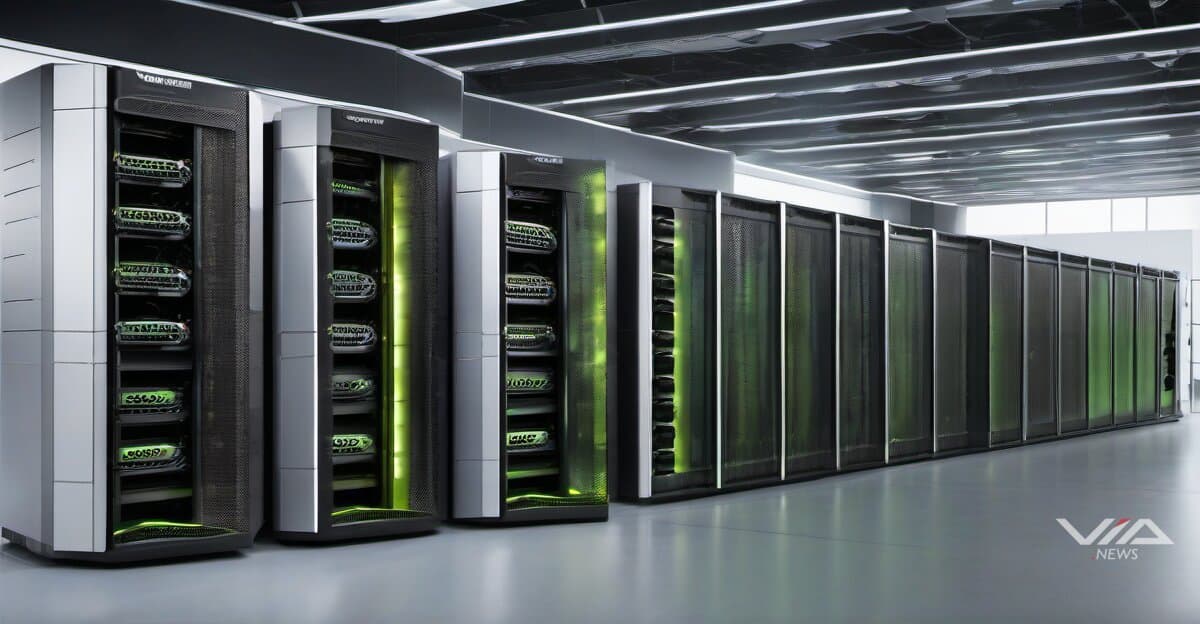
Image generated by AI for illustrative purposes. Not actual footage or photography from the reported events.
Loading stream...

NVIDIA named Dell, Bull SAS, Penguin Solutions, and Doudna Supercomputer as system-builder partners for its Vera Rubin NVL4 rack platform, marking the opening of a new enterprise AI infrastructure procurement cycle.1

The announcements surfaced in the context of ISC High Performance, the annual supercomputing conference where procurement signals often precede large infrastructure orders.1

Dell's specific entry — the PowerEdge XE8812 — points to a configured, market-ready system rather than a reference design. This matters: named products from Tier-1 OEMs compress the time between announcement and deployable supply.1

Penguin Solutions and Bull SAS represent distinct market segments. Penguin targets high-performance computing and national lab deployments. Bull SAS — part of Eviden, Atos's tech spinoff — serves European government and research accounts. Both naming events together suggest NVIDIA is seeding multiple verticals simultaneously rather than sequencing rollout by customer tier.1

Stock movements at Penguin Solutions and Dell correlated with the partner announcements, a pattern consistent with investors pricing in forward procurement exposure ahead of order confirmation.1

The Vera Rubin NVL4 sits at the top of NVIDIA's next-generation compute stack. NVL-class racks integrate GPU compute, high-bandwidth memory, and NVLink fabric into a unified infrastructure unit, reducing integration burden for system builders and shortening deployment timelines for end customers.1

Analysts watching the AI infrastructure supply chain treat named system-builder partnerships as early indicators for component demand. HBM memory suppliers, PCB and interconnect manufacturers, and power infrastructure vendors typically see demand signals 6–12 months ahead of revenue recognition.1

For hyperscalers and national labs evaluating next-generation AI clusters, multi-vendor availability reduces single-source risk — a procurement consideration that has grown in importance since 2024 supply constraints on prior NVIDIA platforms.1

Earnings impact at system integrators is projected to emerge in Q3–Q4 2026, assuming procurement orders follow the historical pattern of building 6–9 months after public partner naming.1

The breadth of the initial partner list — spanning U.S. hyperscale OEM, U.S. HPC specialist, and European government integrator — indicates NVIDIA is pursuing simultaneous global market activation rather than a staged regional rollout.

In this story

About this analysis

This is a Via News analysis. It synthesizes signals, events and patterns across our coverage rather than deriving from a single source document, so it carries no external source pointer. Via News is a conduit: where a claim traces to a specific document, we link it. How we source

L.M. Salvado

L.M. Salvado is an AI possibilist — he takes the risks of AI seriously, and still sees the route through them. Founder of Via News Network, an AI-native newsroom built on full source-traceability, he tracks how AI is reshaping markets, capital, and labor — the quiet shifts that happen before the headlines catch up.