
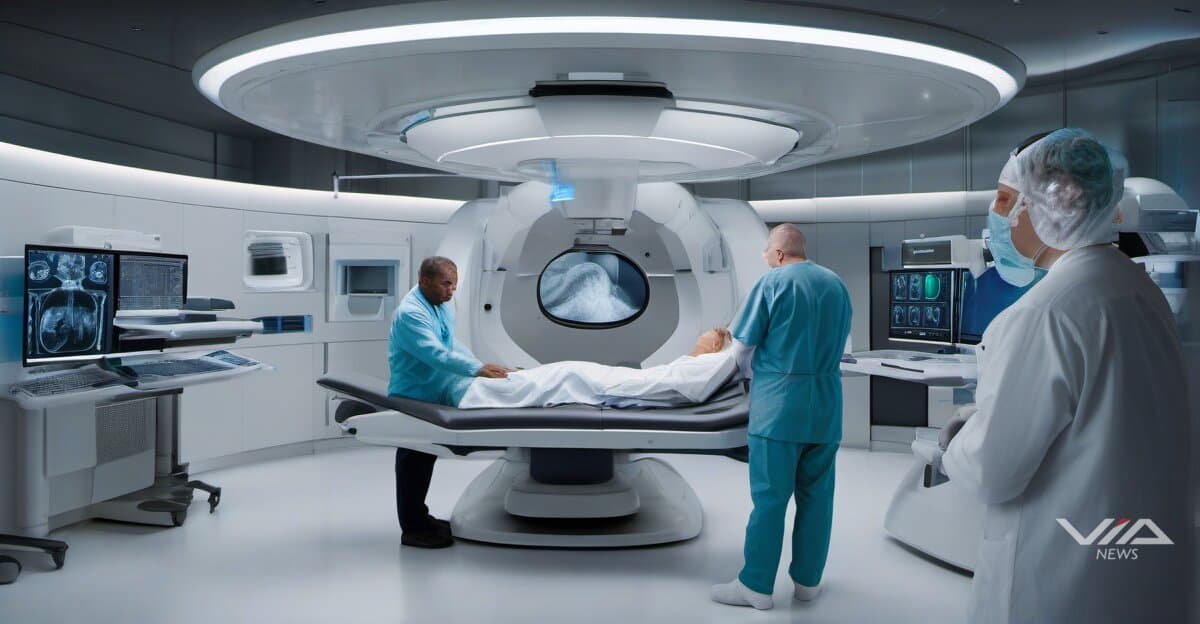
The clearest AI claim in this week's oncology material is also the least checked. In an article titled "How AI helps scientists design the next generation of medicines," AstraZeneca's Puja Sapra describes a 'lab of the future' in which software proposes molecules and robots test them.1 Our reliability check on that article's source, MIT Technology Review, found that 0% of 11 checked claims held up.1 That does not make Sapra wrong. It means her statements below are her own account, not independently confirmed fact, and we attribute them as such.
The oncology pipeline that AI is meant to speed up is moving with or without it. This piece covers the AI argument first, then the late-stage drugs, and ends with the one set of company numbers we can fully verify.
The pitch: data is the moat
Sapra's central claim is about data, not model architecture. She says: "Data is our differentiator. We've built an intentionally diverse portfolio across multiple disease areas and drug types. All of that data empowers us to fine-tune frontier AI models with richer, more representative training sets."1 In the source's framing, those datasets cover molecular structures, binding measurements, safety profiles and manufacturing outcomes.1 For AI watchers the point is that the bet rests on proprietary, multimodal data that a rival cannot download.
She describes the loop with an analogy: "Where a self-driving car uses sensors and models to navigate its environment, this system uses AI to make predictions, robotic systems to execute experiments, and instruments to generate data."1 She expects the automation to "generate AI-ready data at a scale that traditional workflows cannot match," with robotic sample handling and integrated pipelines that could "help accelerate early drug development timelines significantly."1
The target is multi-specific biologics, which bind several disease targets at once. Sapra says such models "could help identify which two or three targets to prioritize based on the underlying biology, then optimize across multiple parameters to balance a molecule's potency, stability, manufacturability, and safety."1
The admitted weak point: safety
The most useful sentence in the piece is a concession. Sapra writes: "One of the hardest problems in de novo design is predicting whether a computationally generated molecule will be safe in the human body."1 Her proposed answer is virtual clinical trials built on advanced cell systems and micro-scale organ models. She says these have the potential "to generate enhanced biological signals without traditional testing bottlenecks" and are "a critical missing piece in closing the loop between AI-generated designs and clinical-ready candidates."1 She also stresses that "human oversight remains at the heart of this approach."1
Read plainly, that means the loop is not closed yet. Design and lab testing can be automated. Predicting safety in people is the step she calls a missing piece. Nothing in our dossier shows an AI-designed oncology drug that has reached the clinic.
Meanwhile, human-designed drugs are hitting milestones
The late-stage events recorded this month did not need AI. They are:
- Ivonescimab: Summit's Biologics License Application, based on the HARMONi trial, carries an FDA decision date of November 14, 2026.2
- EXCALIBER-RRMM: the Phase 3 topline showed median progression-free survival of 42 months for ZDd against 20 months for DVd (HR 0.49, p<0.000001), a 51% reduction in risk of progression or death. Median follow-up was 23 months.3
- Intismeran: Moderna and Merck plan to present detailed results at ESMO on October 24 and to engage regulators about potential filings.4
- Tecentriq: the FDA approved it for adjuvant stage III dMMR colon cancer, its twelfth U.S. indication, based on the Phase III ATOMIC study.5
Talent is also moving. Everest Medicines hired two former Moderna oncology scientists on October 9: Lakshmi Srinivasan as SVP, Head of Translational Medicine, and Brandon Coder as VP, Translational Sciences & Discovery.67 Both previously worked on oncology translation and cancer vaccines at Moderna.67
Consolidation is the other half of the story
On October 6, McKesson and Clayton, Dubilier & Rice announced a take-private of Option Care Health at $32.05 per share, a 37% premium to its prior close, valued at $5.8 billion including debt. CD&R would own 51% and McKesson 49%.8 The dossier does not say how the deal bears on AI.
The one company we can audit: Summit
Summit Therapeutics, the company behind ivonescimab, is the only firm in this story with audited figures in our verified data. The numbers show what a pre-revenue late-stage programme costs.
Revenue was $0 in both FY2023 and FY2024.9 Net loss was $614.9 million in FY2023 and $221.3 million in FY2024. It then reached $1.08 billion in FY2025, nearly five times the prior year.10 Loss per share was $0.99 in FY2023, $0.31 in FY2024 and $1.44 in FY2025.10 Operating cash outflow rose from $76.8 million to $142.1 million to $322.9 million over the same three years.11 Capital expenditure stayed small at $128,000, $139,000 and $657,000.12
Cash was $104.9 million at the end of FY2024 and $225.3 million at the end of FY2025.13 In 2026 it was $106.5 million in Q1 and $419.4 million in Q2.13 The dossier does not say what produced the Q2 increase, so we make no claim about it. We also do not project how long the cash lasts.
The loss in FY2025 is larger than the cash outflow from operations. The two measures differ, and the dossier does not explain why, so we do not attribute the gap to a cause.
How far to trust each source
Our measured reliability varies by source. For the Gilead, Novocure and similar wire-service documents in this batch, 56% of 4,957 checked claims held up.14 For the Telix release it was 31% of 2,928.15 For the weekly biotech roundup it was 46% of 520.16 The MIT Technology Review article, which carries every AI claim above, scored 0% of 11.1 Only the Summit figures are checked against SEC filings.9
In the same roundup, ADC Therapeutics said a workforce reduction is "projected to deliver $10 million in annualised cost savings" and that it "maintains a cash runway into 2028."16 Those are the company's own statements.
What to watch
- October 24: detailed intismeran data at ESMO.4
- November 14: the FDA decision date for ivonescimab.2
- The AI claim: a named oncology candidate that came out of the 'lab of the future' and reached a trial. Until one appears, the AI story is a stated strategy with the safety step still open.1