
The AI claim is the least verified part of this wave
Oncology goes into ESMO 2026 with real regulatory momentum. The European Medicines Agency's CHMP committee adopted a positive opinion on RASONQUE (daraxonrasib), an oral once-daily tablet for metastatic pancreatic cancer, and another on a new Libtayo dosing schedule.7 Antibody-drug conjugates are the main investment theme. For a technology reader, though, the question is what AI is actually doing in this pipeline. The honest answer is that the dossier holds a clear statement of intent and no measured result.
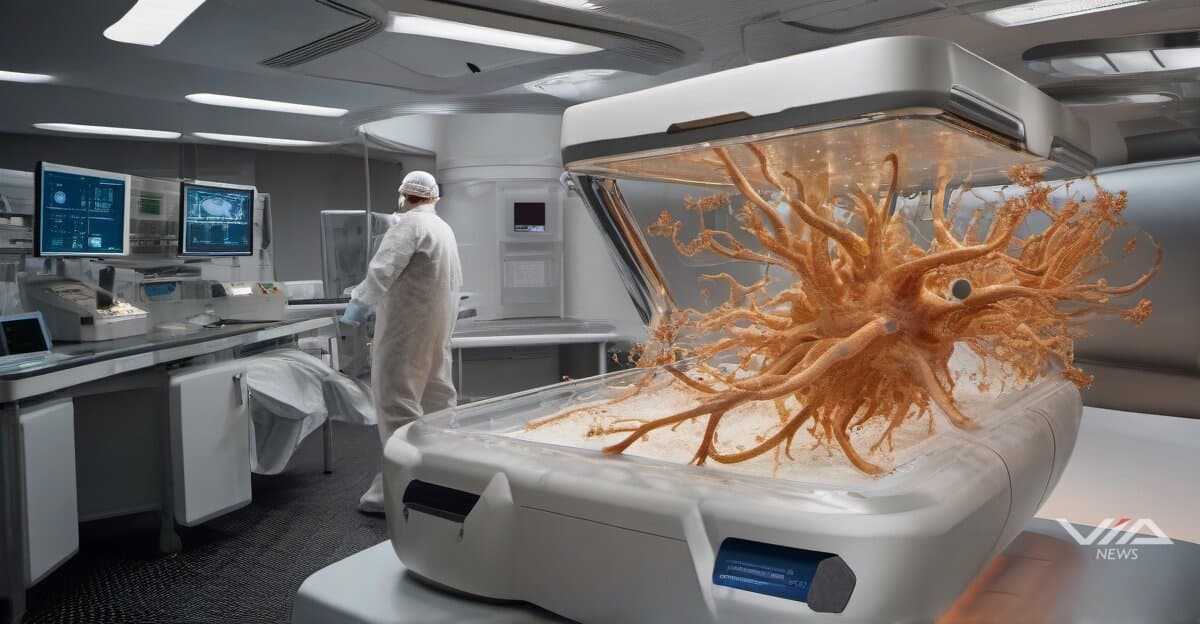
The intent comes from Puja Sapra in an MIT Technology Review piece. She describes a 'lab of the future' in which, in her words: "Where a self-driving car uses sensors and models to navigate its environment, this system uses AI to make predictions, robotic systems to execute experiments, and instruments to generate data."1 Our narrative record ties this push to AstraZeneca, but the dossier does not say who employs Sapra. We therefore do not attribute her statements to any company.
One caution matters more than the quotes. Our reliability check on that MIT Technology Review document found that 0% of 11 checked claims held up.1 That sample is small. It does not show that the quotes are misattributed, and the passages below are verbatim. It does mean nothing in that article has been independently confirmed, and readers should treat it as a vision statement rather than evidence of performance.
What the vision actually claims
The article is useful because it names the hard problems. Sapra writes: "One of the hardest problems in de novo design is predicting whether a computationally generated molecule will be safe in the human body."1 Safety prediction is the step that decides whether AI-designed molecules ever become medicines, so an admission that it remains unsolved is more informative than the optimism around it.
The proposed answer is a design loop. For multi-specific biologics, she says, "such models could help identify which two or three targets to prioritize based on the underlying biology, then optimize across multiple parameters to balance a molecule's potency, stability, manufacturability, and safety."1 The conditional matters: 'could help' describes a capability still to be demonstrated.
Automation is meant to feed the models. Sapra says high-throughput systems "will generate AI-ready data at a scale that traditional workflows cannot match," and that robotic sample handling, automated quality checks and integrated data pipelines could "help accelerate early drug development timelines significantly."1 For the safety gap she points to virtual clinical trials built on advanced cell systems and micro-scale organ models, which she calls "a critical missing piece in closing the loop between AI-generated designs and clinical-ready candidates."1
She also keeps humans in the loop: "With more autonomous systems, human oversight remains at the heart of this approach—ensuring explainable and ethical AI for the benefit of patients."1 And: "Scientists will work hand-in-hand with these model systems. There will be a world where models will design molecules, then scientists will work with the systems to test those molecules and put all that data together."1 The tense is future throughout. The piece also describes a shift toward agentic systems that generate candidates and predict efficacy and safety together, because, as she puts it, "The complexity of the biology goes hand-in-hand with the design of the molecule."1
Where the money is going: ADCs and the cost of getting there
The investment theme is ADCs. AbbVie says it will present new and updated data across seven assets in lung, colorectal, ovarian, prostate and gastric cancers, its largest ESMO program to date.7 Akari Therapeutics is pitching to ADC-refractory patients. The company calls them "a significant, growing unmet need" and an exclusive opportunity for its novel payload, which it says current and most future ADCs will not be able to access.2 That is a company's own claim, not a finding, and Akari plans Phase 1 development for AKTX-101 only in mid-2027.2 Our narrative record also notes a new trial collaboration among Summit, AstraZeneca and Daiichi Sankyo, though the dossier gives no terms.
Summit Therapeutics shows what this kind of bet costs. Its SEC filings, which we treat as verified, show zero revenue in both FY2023 and FY2024.4 Net loss was $614.9 million in FY2023, $221.3 million in FY2024 and $1,079.6 million in FY2025, roughly five times the prior year.4 Cash used in operations rose from $76.8 million in FY2023 to $142.1 million in FY2024 and $322.9 million in FY2025.4 Capital expenditure also rose, from $139,000 in FY2024 to $657,000 in FY2025.4
Funding has kept pace with spending. Year-end cash was $71.4 million for FY2023, $104.9 million for FY2024 and $225.3 million for FY2025.4 The latest quarterly figures are less steady: $106.5 million in Q1 2026, then $419.4 million in Q2 2026.4 The filings give the amounts but not the reason for the jump, so we do not speculate on it. The pattern is of a company with no sales whose spending is growing and whose funding keeps arriving.
Evidence that is real, and less glamorous
The regulatory and commercial signals in this wave come from conventional medicine. The CHMP recommended Gilead's Trodelvy plus Keytruda in first-line PD-(L)1-positive metastatic triple-negative breast cancer.5 Novocure reported Q2 2026 net revenues of $184 million, up 16% year on year, with 18% global active patient growth.3 CEO Frank Leonard called it "our strongest quarter to date, with record net revenues and active patients on therapy."3 Kyowa Kirin's final MINT analysis of 109 patients in 18 German centres reported a median time-to-next-treatment of 14.9 months and a 62.4% best overall response rate for mogamulizumab.6
These are outcomes in patients or revenue in a ledger. The AI claims above are not yet in that category.
Source reliability and a date discrepancy
Most of the press-release material comes from NewsEOD, where 56% of 5,087 checked claims held up.2,3,5,6 Company announcements are statements by interested parties, and we present them that way. Reporting also diverges on timing. Our narrative record gives ESMO as October 23-24, while the event record lists the Congress as October 23-27, 2026 in Madrid.7 We use the event record's dates. Moderna and Merck plan to present detailed intismeran results on October 24.7
What to watch
- Safety prediction: any ESMO or company disclosure that attaches a measured result to AI-designed molecules. Sapra named this as the hardest problem, so a number would matter more than a roadmap.
- Akari's timeline: its Phase 1 start for AKTX-101 is planned for mid-2027, so near-term news is positioning rather than data.2
- Summit's next filing: whether cash after Q2 2026's $419.4 million keeps pace with operating outflows that reached $322.9 million in FY2025.4
- AbbVie's data: its seven-asset program is the broadest test of the ADC theme this week.7