
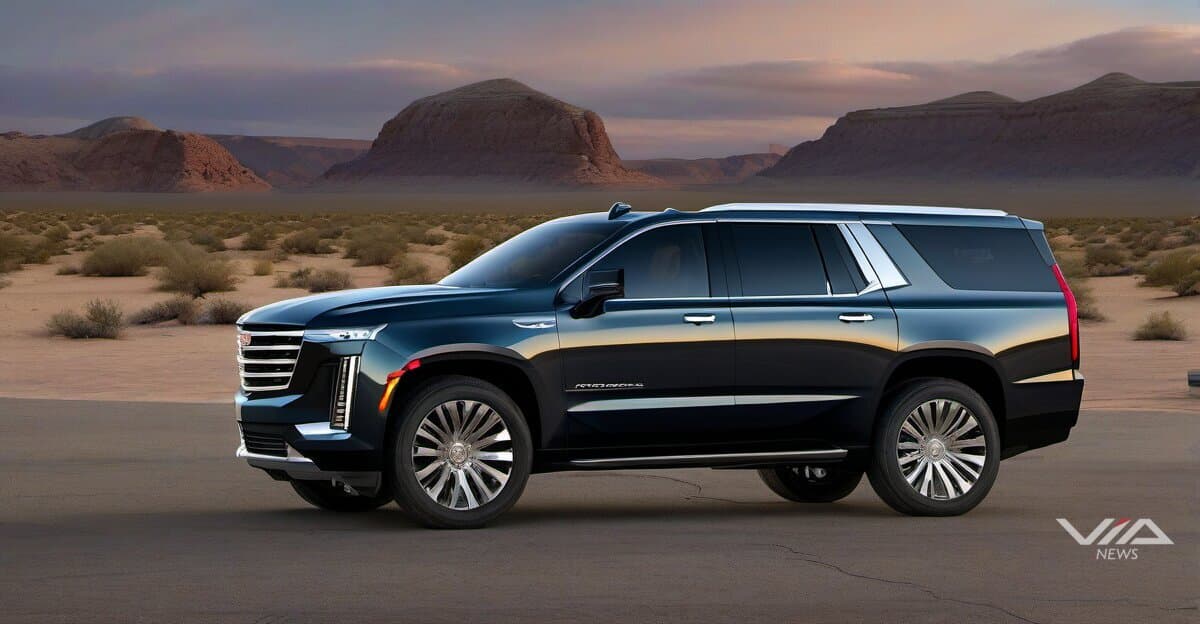
When General Motors unveiled its 2028 roadmap during its Q4 2025 earnings call, buried beneath the headline financial figures was an announcement that carries profound implications for the future of autonomous driving: a second-generation software-defined vehicle (SDV 2.0) architecture set to debut in the Cadillac Escalade I.
The numbers are striking. GM's SDV 2.0 promises 1,000 times more in-vehicle bandwidth and 10 times the over-the-air (OTA) update capacity compared to its first-generation platform — all routed through a single centralized compute core rather than the fragmented network of dozens of electronic control units (ECUs) that have defined automotive electronics for decades.
The Case for Centralization
Modern vehicles already carry between 50 and 150 individual ECUs, each responsible for a discrete function — engine management, braking, climate, infotainment. This distributed architecture was pragmatic when cars were primarily mechanical systems with bolt-on electronics. But autonomous driving changes the equation entirely.
Real-time autonomy demands that sensor data from cameras, lidar, radar, and ultrasonic arrays be fused, interpreted, and acted upon in milliseconds. Routing that data across a patchwork of isolated controllers introduces latency, redundancy overhead, and software complexity that scales poorly. A centralized compute core — essentially a powerful onboard AI server — eliminates those bottlenecks by processing everything in one place.
Tesla pioneered this approach with its Full Self-Driving computer, and Nvidia's DRIVE platform has pushed the same philosophy. GM's SDV 2.0 signals that the industry's largest traditional automaker is now fully committed to the same architectural principle.
Bandwidth as the Limiting Factor
The 1,000x bandwidth figure deserves particular attention. Current automotive ethernet backbones typically operate at 100Mbps to 1Gbps. A 1,000x leap would push that into the terabit range — the kind of throughput needed to handle uncompressed sensor streams from a full autonomous sensor suite simultaneously.
This matters because perception quality degrades when data is compressed or sampled before reaching the inference engine. High-bandwidth architecture means the AI sees richer, more complete data, which directly improves decision-making at speed. For highway autonomy and urban navigation alike, that fidelity gap is the difference between a system that works in controlled conditions and one that handles edge cases reliably.
OTA as a Competitive Moat
The 10x OTA capacity expansion addresses a different dimension of the SDV strategy: continuous improvement after the vehicle leaves the factory. With greater OTA throughput, GM can push larger model updates, new autonomous driving features, and safety patches far more rapidly than the current generation allows.
This transforms the vehicle from a fixed product into a software platform — one that appreciates in capability over time rather than depreciating purely on hardware age. It also positions GM to compete with Tesla's well-established OTA ecosystem, which has long been a benchmark the traditional industry has struggled to match.
The Escalade I as a Proving Ground
Selecting the Cadillac Escalade I as the launch vehicle for SDV 2.0 is a strategic choice. The Escalade commands premium pricing and a loyal customer base willing to absorb technology-forward features. It also provides the physical space and power budget that a high-performance compute core currently requires before miniaturization matures.
If SDV 2.0 validates in the Escalade, the architecture cascades across GM's broader lineup — potentially reaching Chevrolet and GMC platforms within a few model years, bringing centralized AI compute to mass-market volumes.
The 2028 launch is still two years away, and the autonomous driving landscape will shift considerably before then. But GM's architectural commitment signals that the race for real-time vehicular AI is no longer a startup story — it is now a core pillar of the world's largest automakers.