
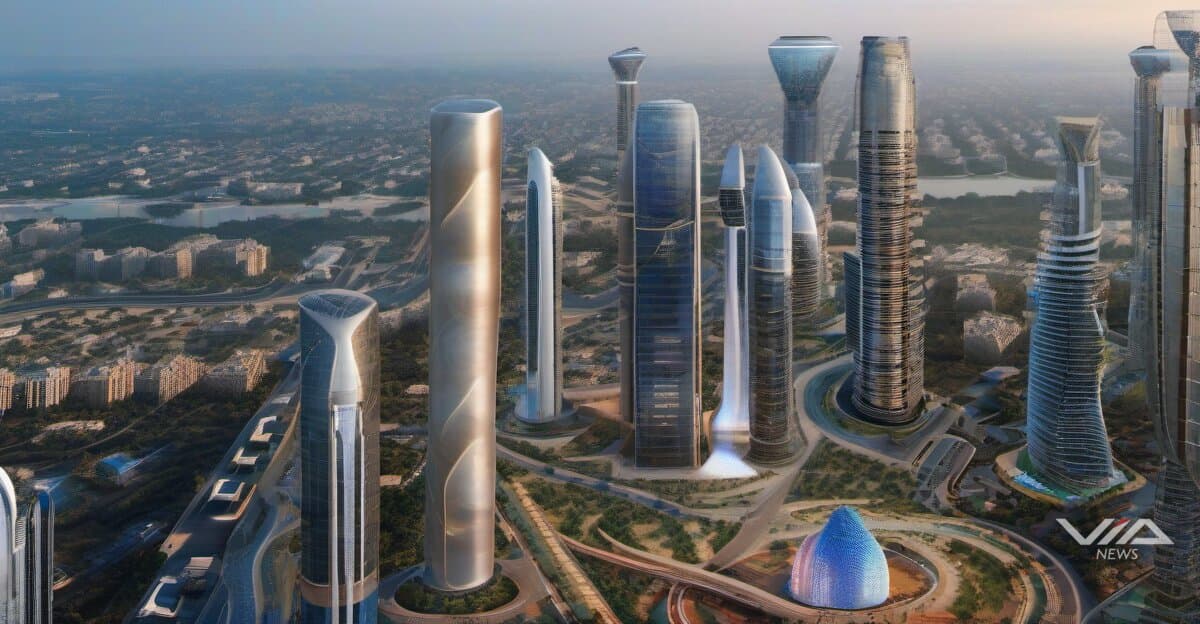
Reliance Industries chairman Mukesh Ambani announced a $110 billion investment in India's AI infrastructure, marking the country's largest technology commitment. The funds target GPU clusters, data centers, and local AI model development through 2030.
Tata Group signed a partnership with OpenAI to build India-based data centers, joining Microsoft's existing $2.1 billion cloud infrastructure expansion in the region. The deals position India as a compute hub for Asia-Pacific AI workloads, not just a software development outsourcing center.
Sarvam AI released its first production model trained specifically on Indian languages and cultural contexts. The model processes Hindi, Tamil, and Telugu with 40% better accuracy than GPT-4 on regional queries, according to company benchmarks. Anthropic opened its second international office in Bangalore, hiring ML engineers for Claude development.
India's AI emergence parallels global deep learning expansion driven by advanced GPU architectures. NVIDIA's Hopper H100 chips now power 70% of large-scale model training, while AMD's Instinct MI300 accelerators gained 12% market share in enterprise deployments. Intel's AMX extensions brought matrix multiplication to standard Xeon processors, reducing inference costs by 35%.
Healthcare applications dominate deep learning adoption. Computer vision models detect diabetic retinopathy with 94% accuracy across five major hospital networks. Genomics pipelines using transformer architectures cut cancer diagnosis time from weeks to 48 hours. Enterprise networks deploy deep learning for anomaly detection, processing 50TB of log data daily at financial institutions.
India's localized model development addresses a critical gap. Western AI models struggle with code-switching between English and regional languages, a pattern used by 600 million Indian internet users. Sarvam's approach trains on conversational datasets mixing languages within single sentences, matching real usage patterns.
The infrastructure investments create GPU availability closer to Asian markets. Current cloud GPU instances in Mumbai cost 15-20% less than equivalent U.S. capacity due to power and cooling cost advantages. Latency for Indian users drops from 180ms to 40ms when models run locally versus U.S. data centers.
India now ranks third globally in AI research publications, up from eighth position in 2022. The country produces 25,000 ML engineering graduates annually, with average salaries at $28,000 versus $160,000 in Silicon Valley for equivalent roles.