
Monday, September 28, 2026

Accenture Flags 'AI Demand Compression' as Enterprise Software Stocks Crater

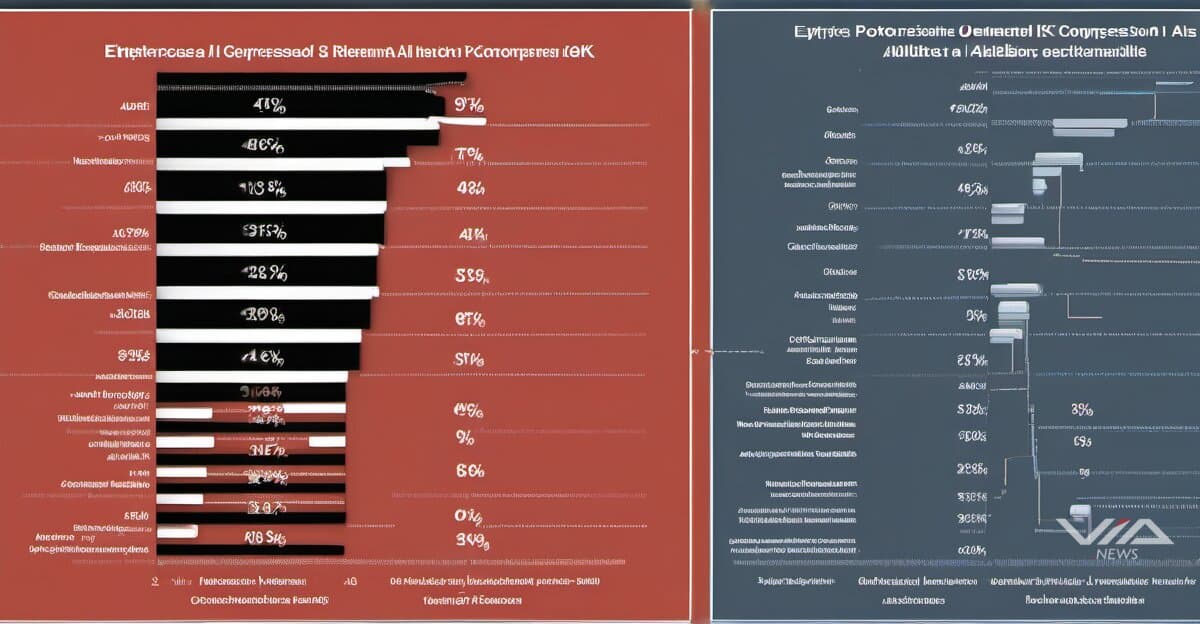
Enterprise AI software vendors are showing severe, clustered underperformance: Salesforce is down 43% year-to-date, Adobe 49% year-over-year, and Atlassian 4.6%. Accenture's explicit use of 'AI demand compression' in a guidance cut signals a structural ROI credibility problem across the sector. IBM, Infosys, and Cognizant face similar pressure as enterprise clients pause AI spend.

LM Salvado

June 25, 2026

Accenture Flags 'AI Demand Compression' as Enterprise Software Stocks Crater
Image generated by AI for illustrative purposes. Not actual footage or photography from the reported events.
Loading stream...

Enterprise AI software vendors are hitting a demand wall. Accenture explicitly cited "AI demand compression" in its latest guidance cut — a phrase that crystallizes what multiple stock charts already show.1 The clustering across vendors is not coincidence — it signals a sector-wide ROI credibility problem.

The pattern points to a specific failure mode. Enterprise clients spent 2023–2025 buying AI tooling. Now procurement teams are asking what they received in return. For many organizations, the answer remains unclear.

"AI demand compression" is an unusual term for an enterprise earnings call. Accenture's decision to use it in formal guidance language suggests the company views the slowdown as structural, not a temporary pause.

The pressure is expected to spread. IBM, Infosys, and Cognizant — significant players in AI consulting services — face equivalent exposure as enterprise clients hold discretionary AI spend.1 Vendor softness in software typically precedes parallel moves in services revenue.

One to two quarters of further multiple compression are likely for this segment.1 Enterprise buyers are not abandoning AI wholesale — they are demanding proof of returns before extending commitments.

The dynamic is separating two categories of AI spend. Infrastructure investment — compute, data pipelines, model access — continues growing. Application-layer and services spend, where ROI is harder to quantify, is stalling.

For Salesforce and Adobe, the challenge is converting AI feature adoption into measurable business outcomes. Adobe's generative tooling and Salesforce's agentic platform both face the same test: show that AI integration drives revenue retention, not just capability expansion.

Atlassian's smaller drop relative to peers may reflect its tighter integration into developer workflows, where productivity gains are easier to instrument and demonstrate to budget holders.

The next one to two quarters will determine whether enterprise AI services face a temporary demand pause or a permanent repricing. Vendors who can surface concrete ROI data — cost savings, cycle time reduction, measurable output gains — will exit this cycle at a lower multiple discount than those who cannot.

In this story

About this analysis

This is a Via News analysis. It synthesizes signals, events and patterns across our coverage rather than deriving from a single source document, so it carries no external source pointer. Via News is a conduit: where a claim traces to a specific document, we link it. How we source

LM Salvado

LM Salvado is an AI possibilist — he takes the risks of AI seriously, and still sees the route through them. Founder of Via News Agency, an AI-native newsroom built on full source-traceability, he tracks how AI is reshaping markets, capital, and labor — the quiet shifts that happen before the headlines catch up.

What we know · the intelligence behind this page
Live from the substrate
What we're seeing
Vertical AI Agents Attract a Funding Wave Across Fintech-Adjacent Industries
A cluster of AI-native startups applying autonomous agents to narrow, operational problems — hotel front-desk staffing (Dextr AI), identity/fraud risk for financial institutions (Baselayer), insurance distribution (Napo, Connie Health, MGT Insurance) — closed seed-to-Series A rounds within days of each other in September 2026, with CB Insights running a coordinated CEO interview series to spotlight them. The pattern points to agentic AI maturing from generic chat tools into vertical, revenue-generating products, with identity verification for AI agents themselves (Baselayer) emerging as a new fintech infrastructure category responding directly to AI-driven fraud risk.
Our read on the data ›
Signals we're tracking
Satellite-Terrestrial Network Integration Acceleration
Increased investment and launches in hybrid satellite-cellular networks across telecom industry; competitive responses from other carriers; regulatory activity around satellite spectrum; expansion of emergency/rural connectivity use cases
Patterns we're watching ›
Where sources disagree
Berkshire Hathaway
Both facts report Berkshire Hathaway's cash position on 2026-01-01 with identical observation timestamps, but claim vastly different values: 380 billion USD vs 400 USD. These cannot both be true for the same entity at the same point in time. The magnitude of the discrepancy (a factor of ~10^9) rules out rounding, unit conversion, or methodological differences.
We flag conflicts openly ›
Recently verified
✓ Checked against the original source
4,984
facts traced to their source — and we flag the ones that don't hold up.
101 entities tracked4,984 facts checked against source5,306 source documents archived
Query this data → isubstrate.com