
Sunday, August 30, 2026

Cloud Giants and NVIDIA Are Building the Backbone of Enterprise Agentic AI

Major financial institutions including HSBC, BNP Paribas, and Citigroup are accelerating agentic AI deployments through deep partnerships with Google Cloud, Microsoft Azure, and AWS. Meanwhile, NVIDIA is pushing AI beyond software into physical systems, signaling that the next frontier of enterprise AI is autonomous, embodied, and deeply infrastructure-dependent.

Cloud Giants and NVIDIA Are Building the Backbone of Enterprise Agentic AI
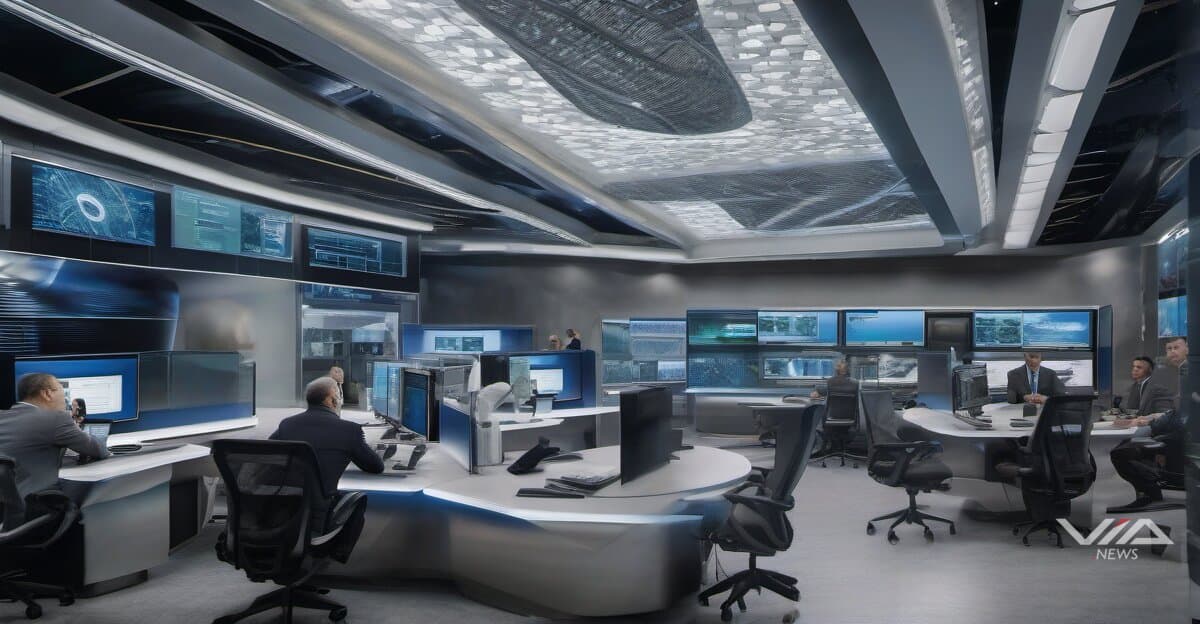
Image generated by AI for illustrative purposes. Not actual footage or photography from the reported events.
Loading stream...

The enterprise AI stack is hardening fast. Across banking boardrooms and data center corridors, a structural shift is underway — one where AI is no longer a pilot project but a core operational layer, powered by a tight web of cloud providers, LLM vendors, and hardware manufacturers.

Some of the world's largest financial institutions are leading the charge. HSBC, BNP Paribas, Lloyds, Citigroup, and Wells Fargo have each deepened commitments to agentic AI platforms — systems capable of autonomous reasoning, multi-step decision-making, and workflow execution with minimal human intervention. Their deployments are built atop infrastructure from Google Cloud, Microsoft Azure, and Amazon Web Services, reflecting a clear enterprise preference for hyperscaler-grade reliability over point solutions.

The LLM vendor landscape is consolidating around this demand. Mistral AI, the Paris-based model maker known for its sovereign-friendly, open-weight language models, closed a $1.5 billion Series C — one of the largest funding rounds in European AI history. The raise underscores appetite for LLM providers that can operate within strict regulatory and data residency constraints, a non-negotiable for institutions operating across EU jurisdictions. Mistral's positioning as an enterprise-ready, compliance-conscious alternative to US hyperscaler models is proving commercially potent.

But the most consequential signal may be coming from hardware. NVIDIA has begun releasing open physical AI models and expanding robotics collaborations, marking a deliberate push beyond the data center and into the physical world. The company's work on embodied AI — systems that perceive, reason, and act in real environments — suggests that the agentic paradigm is not confined to software automation. Warehouse logistics, industrial inspection, and autonomous vehicle coordination are among the near-term deployment vectors where NVIDIA's physical AI stack is gaining traction.

The capital conviction behind this trajectory is substantial. Tesla's $2 billion investment into xAI, Elon Musk's AI venture, adds another data point to a funding environment where infrastructure-layer bets are attracting sovereign-scale capital. Whether through model training, inference optimization, or robotics integration, the message is consistent: the agentic AI era requires purpose-built infrastructure at every layer of the stack.

For enterprise buyers, the implications are strategic. Agentic AI is not a drop-in upgrade — it demands rearchitected workflows, new governance frameworks, and vendors who can operate at the intersection of compliance, latency, and scale. The financial sector's adoption pace is setting a template that other regulated industries — healthcare, legal, energy — are watching closely.

What's emerging is less a product category than a new infrastructure paradigm: one where cloud providers supply the compute fabric, LLM vendors supply the reasoning layer, and hardware manufacturers like NVIDIA supply the physical execution substrate. The enterprises that move earliest to integrate these layers cohesively will hold durable operational advantages. The race to build that stack — and the capital flowing into it — suggests the window for strategic positioning is narrowing.

Source documents

Via News is a conduit. We point to the source documents behind this report — we don't replace them. Trace any claim to its source and decide what to trust. How we source

Source Trace Score3 source documents3 with a live linkVerifiability: Strong
  1. [1]News articleYahoo Finance· December 3, 2025
    From Maps to Mission Control: Inside HERE’s Strategy for EVs, L2+ Automation and the SDV Era
  2. [2]Press releaseGlobeNewswire· February 2, 2026
    How Automation Is Transforming Service Speed, Revenue in High-Demand Hospitality Environments
  3. [3]News articleCB Insights
    Retail banking AI readiness: the leading banks positioned to enable AI at scale

In this story

What we know · the intelligence behind this page
Live from the substrate
What we're seeing
Enterprise AI's Trust Gap: Microsoft-Mistral Ecosystem Expansion Meets a Governance Deficit in Agentic Adoption
Microsoft is deepening its AI platform bet through simultaneous moves — expanding its Mistral partnership (Copilot Studio, Foundry, European infrastructure capacity) and deepening enterprise AI governance ties with Manulife — just as independent research (Google Cloud, VentureBeat, Box) shows enterprises racing toward agentic AI adoption (100% planned within two years) while data access and trust in agent decisions lag badly (average 45% data access, only ~half trust agent outputs). The result is a structural mismatch between platform-vendor momentum and enterprise readiness to actually govern and trust the agents being deployed.
Our read on the data ›
Signals we're tracking
EPKINLY Regulatory-Clinical Success Cascade
High probability of expanded label indications, additional combination approvals, and competitive positioning strength in follicular lymphoma market. Predicts positive commercial uptake and potential accelerated review for related indications.
Patterns we're watching ›
Where sources disagree
Morgan Stanley & Co. LLC
Same entity (Morgan Stanley & Co. LLC), same metric (net_income), same fiscal period (Q1 2026), same observation date (2026-03-31), but vastly different values: $5.567 billion vs. $5.57. These cannot coexist for the same time period. Fact B appears to be a data entry error (possible missing decimal placement: 5.57 should likely be 5,567,000,000 or a per-share figure incorrectly entered as total).
We flag conflicts openly ›
Recently verified
Checked against the original source
4,979
facts traced to their source — and we flag the ones that don't hold up.
101 entities tracked4,979 facts checked against source5,257 source documents archived
Query this data → isubstrate.com