
Thursday, September 10, 2026

Meta raises AI capex to $65B as AMD, Cisco ship infrastructure for production deployments

Meta increased 2026 capital expenditures to $60-65B for AI data center expansion, up from $48B in 2025. AMD released ROCm 6.3 GPU software with enhanced deep learning libraries, while Cisco shipped Nexus switches designed for distributed AI training. Research advances in neural architectures and video-based training methods are improving model performance by 20%+ on unseen tasks.

Meta raises AI capex to $65B as AMD, Cisco ship infrastructure for production deployments
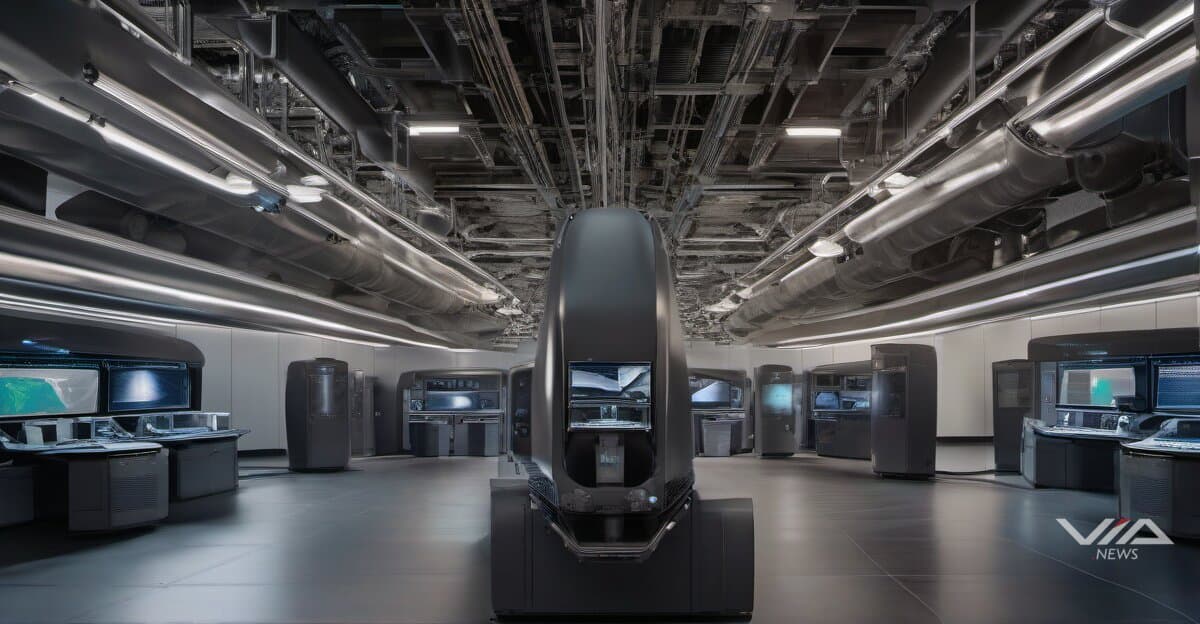
Image generated by AI for illustrative purposes. Not actual footage or photography from the reported events.
Loading stream...

Meta increased capital expenditures for 2026 to $60-65B, allocating most spending to AI data center infrastructure including compute, networking, and storage systems. The company spent $48B in 2025.

AMD released ROCm 6.3 open software platform with updated libraries for PyTorch, TensorFlow, and JAX frameworks. The release includes MIGraphX 2.11 inference engine and enhanced memory optimization for MI300 accelerators.

Cisco launched Nexus 9000 switches with 51.2 Tbps throughput capacity, targeting distributed training workloads across GPU clusters. The networking gear includes remote direct memory access capabilities to reduce training bottlenecks.

Stanford researchers demonstrated video discriminator models trained on human task footage achieve 20%+ higher success rates on unseen robotic tasks compared to robot-only training data. The approach uses Something-Something dataset clips combined with robot interaction episodes.

Scientists evaluated Kolmogorov-Arnold Networks against standard architectures, finding KANs require fewer parameters for symbolic formula tasks but show mixed results on image classification. The architecture uses learnable activation functions on network edges rather than fixed neurons.

Researchers proposed TAPINN neural networks with time-adaptive pattern inference, showing improved performance on temporal prediction tasks. The architecture adjusts inference patterns based on input sequence characteristics.

Autonomous vehicle teams are implementing explainable AI systems that provide passengers with decision rationale through audio, visualization, or haptic feedback. The approach aims to increase rider trust by surfacing factors like detected obstacles or route selection logic.

Medical imaging applications deployed deep learning models for analyzing diagnostic scans, while trading firms adopted vision systems for processing market data visualizations. Enterprises are moving foundation models from research to production environments.

The infrastructure buildout reflects growing compute requirements as organizations scale from prototype to deployment. GPU memory capacity, interconnect bandwidth, and cooling systems are constraining factors for training runs exceeding 10,000 accelerators.

Hardware vendors are releasing annual product cycles aligned with hyperscaler purchasing timelines, competing on performance-per-watt metrics as power costs become a larger portion of total cost of ownership.

Source documents

Via News is a conduit. We point to the source documents behind this report — we don't replace them. Trace any claim to its source and decide what to trust. How we source

Source Trace Score12 source documents12 with a live linkVerifiability: High
  1. [1]Press releaseGlobeNewswire· November 24, 2025
    Nanox.AI Bone Solutions, Advanced AI-Powered Software for Spine Assessment, Recommended by NICE for Early Value Assessment in UK National Health Service hospitals
  2. [2]News articleStanford AI Lab
    Reward Isn't Free: Supervising Robot Learning with Language and Video from the Web
  3. [3]News articleIEEE Spectrum
    Safer Autonomous Vehicles Means Asking Them the Right Questions
  4. [4]News articleYahoo Finance· February 8, 2026
    They Asked Middle-Class Homeowners With $6,000 Mortgages If They Regret It. Some Now Wonder If Renting And Investing Would Have Been Smarter
  5. [5]Press releaseGlobeNewswire· January 23, 2026
    AI in Medical Imaging Market Size to Hit Nearly USD 22.97 Trillion by 2035, Driven by Rising Demand for Early Disease Detection and Workflow Automation
  6. [6]Press releaseGlobeNewswire· January 6, 2026
    AMD Expands AI Leadership Across Client, Graphics, and Software with New Ryzen, Ryzen AI, and AMD ROCm Announcements at CES 2026
  7. [7]News articleYahoo Finance· February 10, 2026
    Azul 2026 State of Java Survey & Report: 62% of Enterprises Now Leverage Java to Power AI Functionality, 41% Rely on High-Performance Java Platforms to Reduce Cloud Compute Costs
  8. [8]News articleYahoo Finance· February 10, 2026
    Cisco Announces New Silicon One G300, Advanced Systems and Optics to Power and Scale AI Data Centers for the Agentic Era
  9. [9]News articleIEEE Spectrum
    Drones Compete to Spot and Extinguish Brushfires
  10. [10]Peer-reviewed paperarXiv
    Empirical Stability Analysis of Kolmogorov-Arnold Networks in Hard-Constrained Recurrent Physics-Informed Discovery
  11. [11]Press releaseGlobeNewswire· January 12, 2026
    Endpoint Security Market Projected to Reach US$ 65.04 Billion by 2035 Amid Rising Cyber Threat Activity | Astute Analytica
  12. [12]News articleYahoo Finance· February 12, 2026
    Flow Traders 4Q and FY 2025 Results
What we know · the intelligence behind this page
Live from the substrate
What we're seeing
AI Capital Boom Meets Valuation Jitters: Funding Surges While Bellwether Stocks Wobble
A dense wave of AI-sector funding (Socure, Stability AI, Emerald AI, Generalist AI, Gatik, Regent Craft and others closing rounds on the same day) and strong enterprise-automation earnings (UiPath raising full-year guidance) point to continued heavy capital deployment into AI infrastructure, fintech-adjacent AI, and agentic automation. Yet Palantir's stock fell even after winning the Army's high-profile TITAN contract, and commentary (e.g., the Alphabet bull case citing AI capex and regulatory risk) signals growing investor unease about whether current AI valuations and spending levels are sustainable.
Our read on the data ›
Signals we're tracking
Satellite-Terrestrial Network Integration Acceleration
Increased investment and launches in hybrid satellite-cellular networks across telecom industry; competitive responses from other carriers; regulatory activity around satellite spectrum; expansion of emergency/rural connectivity use cases
Patterns we're watching ›
Where sources disagree
JPMorgan Chase & Co.
Both facts represent the same entity (JPMorgan Chase & Co.), same attribute (EPS), and same observation date (2025-12-31), which aligns with FY 2025 year-end reporting. Fact A explicitly states FY 2025 with EPS of 20.02 USD/share. Fact B has an unspecified fiscal period (N/A) but reports 4.63 USD, a significantly different value (4.3x lower). Given identical observation dates and the same metric, both facts appear intended to represent FY 2025 annual EPS. The conflicting values (20.02 vs 4.63) constitute a direct contradiction. The N/A period in Fact B suggests incomplete or corrupted metadata rather than legitimate time-period variation.
We flag conflicts openly ›
Recently verified
Checked against the original source
4,981
facts traced to their source — and we flag the ones that don't hold up.
101 entities tracked4,981 facts checked against source5,278 source documents archived
Query this data → isubstrate.com