
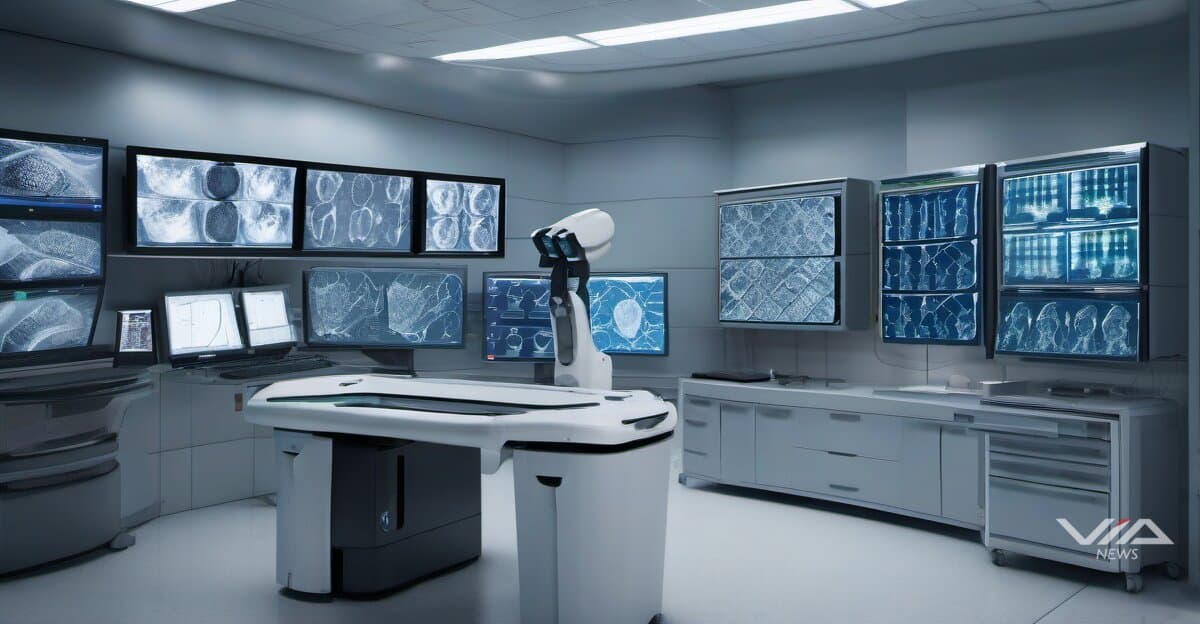
Computer vision AI is scaling across three distinct fronts: clinical diagnostics, autonomous vehicles, and edge computing deployment, marking a shift from lab demonstrations to commercial integration.
Healthcare applications are advancing through specialized medical imaging tools. DeepHealth acquired Gleamer to expand AI-powered diagnostic capabilities, while new algorithms detect breast arterial calcification and track lesions across multiple scans. Accurate detection of merging and splitting lesions proves crucial for reliable response evaluation, as overlooking these events leads to misclassification under RECIST criteria and potentially incorrect assessment of disease progression, according to researcher Melika Qahqaie.
Automotive computer vision is converging with robotics. Mobileye acquired Mentee to combine autonomous driving perception with robotic manipulation capabilities, signaling that vision AI for vehicles and industrial automation share technical foundations worth consolidating.
Edge vision AI is moving from concept to product. VeeaVision AI enables on-device computer vision processing without cloud connectivity, addressing latency and privacy requirements for industrial deployments. Apple's upcoming M5-powered devices feature enhanced camera capabilities optimized for on-device vision processing, while smart glasses development accelerates as manufacturers integrate lightweight vision models.
The horizontal expansion reflects maturing model architectures that transfer across domains. Vision transformers and efficient neural architectures developed for one application—medical imaging, autonomous navigation, or mobile devices—adapt to others with domain-specific fine-tuning rather than ground-up redesign.
Edge deployment solves two problems: latency for real-time applications like surgical guidance or collision avoidance, and privacy for medical imaging where cloud transmission raises regulatory concerns. Industrial customers deploy edge vision for quality control inspection, while consumer applications focus on computational photography and augmented reality overlays.
Healthcare adoption faces regulatory hurdles. Medical imaging AI requires clinical validation and regulatory clearance, slowing deployment compared to consumer applications. Longitudinal lesion tracking algorithms must demonstrate reliability across patient populations before clinical integration.
The convergence of automotive and robotics computer vision suggests shared technical challenges in spatial reasoning, object manipulation prediction, and real-time decision-making under uncertainty. Companies building vision AI for one domain increasingly find adjacent markets accessible with incremental model adaptation.