
Friday, August 21, 2026
What we know · the intelligence behind this page
Live from the substrate
What we're seeing
AI Platforms Rush to Establish Content-Authenticity Standards Amid Leadership Shakeups and Sustained Capex
Within days of each other in mid-August 2026, Google, Anthropic, and Spotify moved to formalize AI content watermarking and labeling policies, signaling an industry-wide push toward self-governed provenance standards as generative AI output floods consumer platforms. The shift coincides with executive turnover at OpenAI (Brad Lightcap's departure) and Meta's public AI manifesto, all set against continued heavy AI infrastructure capital expenditure and finance-sector moves (e.g., Wall Street paying for algorithmic edges on social signals) that underscore AI's deepening entanglement with capital markets.
Our read on the data ›
Signals we're tracking
EPKINLY Regulatory-Clinical Success Cascade
High probability of expanded label indications, additional combination approvals, and competitive positioning strength in follicular lymphoma market. Predicts positive commercial uptake and potential accelerated review for related indications.
Patterns we're watching ›
Where sources disagree
JPMorgan Chase & Co.
Both facts report JPMorgan Chase & Co.'s revenue for the same fiscal period (FY 2025) with the same observation date (2025-12-31), but with different values: $182.447 billion vs. $185 billion. The ~1.4% difference ($2.553 billion) is too large to be explained by rounding alone and represents conflicting data for the identical time period.
We flag conflicts openly ›
Recently verified
Checked against the original source
4,977
facts traced to their source — and we flag the ones that don't hold up.
101 entities tracked4,977 facts checked against source5,242 source documents archived
Work with this data → vianewsagency.com

NVIDIA BioNeMo Platform Powers Autonomous Lab Workflows for Lilly, Thermo Fisher

NVIDIA is positioning its BioNeMo platform as foundational infrastructure for AI-driven drug discovery, securing adoption from Eli Lilly and Thermo Fisher Scientific. The platform serves as middleware connecting AI compute to laboratory automation, enabling pharmaceutical companies to build autonomous research workflows. This infrastructure play establishes NVIDIA in specialized biotech AI tooling beyond its core chip business.

L.M. Salvado

March 23, 2026

NVIDIA BioNeMo Platform Powers Autonomous Lab Workflows for Lilly, Thermo Fisher
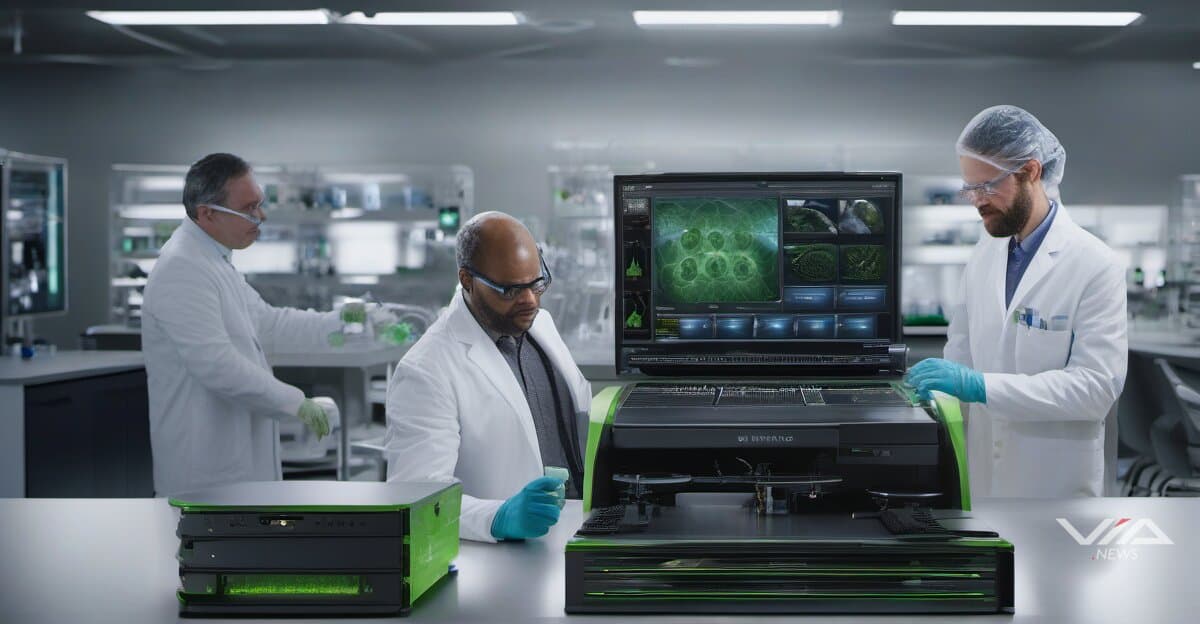
Image generated by AI for illustrative purposes. Not actual footage or photography from the reported events.
Loading stream...

NVIDIA's BioNeMo platform has been adopted by Eli Lilly and Thermo Fisher Scientific to accelerate AI-driven drug discovery workflows. The platform functions as domain-specific infrastructure that bridges general AI compute capabilities with specialized laboratory automation needs.

BioNeMo provides pre-trained models and tools for molecular biology tasks including protein structure prediction, small molecule generation, and genomic sequence analysis. Pharmaceutical companies use the platform to automate experimental design and prediction workflows that previously required manual scientific input at each step.

The Lilly partnership focuses on integrating BioNeMo's molecular AI capabilities into the company's internal drug discovery pipelines. Thermo Fisher is embedding the platform within its laboratory equipment and software ecosystem, allowing researchers to deploy AI models directly alongside physical lab instruments.

This infrastructure approach differs from NVIDIA's traditional GPU sales model. BioNeMo creates a software layer that pharmaceutical companies and biotech startups build applications on top of, similar to how cloud platforms enable developer ecosystems. The platform handles the complexity of adapting general AI models to biological data formats and scientific workflows.

The strategic value lies in establishing NVIDIA as the standard middleware for biotech AI rather than just a hardware supplier. As pharmaceutical companies automate more research processes, BioNeMo becomes embedded in their core operations. This creates switching costs and recurring platform dependencies beyond one-time chip purchases.

The biotech AI market includes both established pharmaceutical giants digitizing legacy research processes and startups building natively AI-driven discovery companies. BioNeMo targets both segments by offering pre-built components that reduce the specialized expertise needed to deploy AI in laboratory settings. This lowers barriers for smaller biotech firms while providing enterprise-grade tools for large pharmaceutical operations.

NVIDIA's vertical integration into domain-specific scientific tooling represents a broader pattern where AI infrastructure companies are moving beyond general-purpose compute into specialized application layers that command higher margins and stickier customer relationships.

Source documents

Via News is a conduit. We point to the source documents behind this report — we don't replace them. Trace any claim to its source and decide what to trust. How we source

Source Trace Score1 source document1 with a live linkVerifiability: Basic
  1. [1]News articleYahoo Finance· January 12, 2026
    NVIDIA BioNeMo Platform Adopted by Life Sciences Leaders to Accelerate AI-Driven Drug Discovery

In this story

L.M. Salvado

L.M. Salvado is an AI possibilist — he takes the risks of AI seriously, and still sees the route through them. Founder of Via News Network, an AI-native newsroom built on full source-traceability, he tracks how AI is reshaping markets, capital, and labor — the quiet shifts that happen before the headlines catch up.