
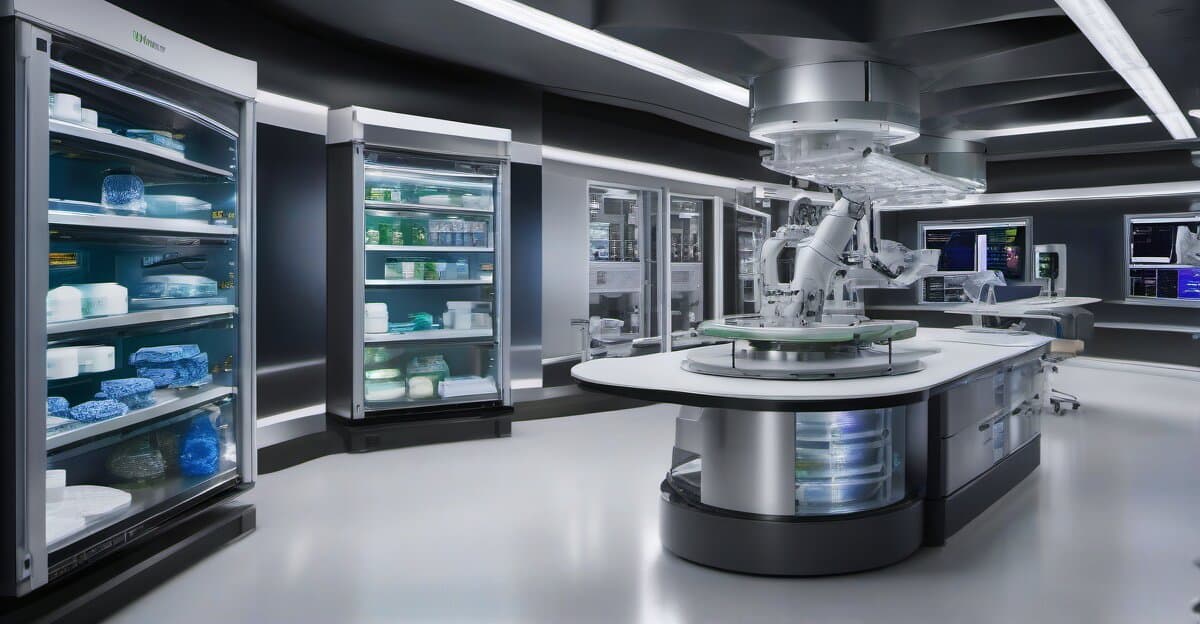
The laboratory of the future may look less like a room full of centrifuges and more like a data center. NVIDIA is making an aggressive push to ensure its BioNeMo platform sits at the center of that transformation, positioning the framework as essential infrastructure for pharmaceutical and biotech research in much the same way CUDA became indispensable for general-purpose GPU computing.
High-profile partnerships announced in early 2026 with Thermo Fisher Scientific and Eli Lilly have provided the kind of institutional credibility that accelerates enterprise adoption. Thermo Fisher, the world's largest life sciences instrument and reagent supplier, brings BioNeMo into direct contact with laboratory workflows at scale. Eli Lilly's involvement signals that major pharma incumbents are no longer treating AI as a peripheral experiment — they are building it into core R&D operations.
"Foundation models are becoming the operating system of drug discovery," is a phrase increasingly heard across biotech boardrooms, and the data supports the analogy. Just as enterprise software companies once standardized on cloud platforms from AWS or Azure, life sciences firms appear to be converging on a small number of AI platforms capable of handling the complexity of biological data — genomics, proteomics, molecular dynamics — at the scale modern drug pipelines demand.
A Maturing Ecosystem
What makes the current moment distinctive is not just NVIDIA's institutional moves, but the simultaneous emergence of a broader ecosystem of specialized biotech AI models. Companies including Natera, Basecamp Research, Boltz, Owkin, and Edison Scientific have each launched or expanded purpose-built biological AI models in recent months. Each targets a different slice of the discovery pipeline: genetic variant interpretation, biodiversity-derived compound libraries, protein structure prediction, federated clinical data analysis, and scientific literature reasoning, respectively.
This ecosystem dynamic is significant. Rather than a single platform monopolizing the space, the pattern resembles the early cloud era, where a dominant hyperscaler (here, NVIDIA for compute) coexists with a proliferating layer of specialized application vendors. Investors in life sciences venture capital are paying close attention to where platform-layer value accrues versus application-layer commoditization.
Structural Shift in Research Financing
The convergence of hyperscaler compute, pharma incumbents, and AI-native startups represents a structural shift in how biological research is financed and operationalized. Traditional drug discovery timelines — often measured in decades and billions of dollars — face competitive pressure from AI-accelerated pipelines that compress molecular screening and lead optimization into months rather than years.
For laboratory automation specifically, the implications are concrete. BioNeMo's integration with Thermo Fisher's instrumentation stack suggests a near-term future where AI models generate hypotheses, robotic systems execute experiments, and the resulting data feeds back into model refinement — a closed-loop system that reduces human bottlenecks at each stage.
The confidence around this transformation remains calibrated, not euphoric. Regulatory pathways for AI-derived drug candidates remain unsettled, and the gap between model capability and clinical validation is still wide. But the infrastructure investment patterns of 2025 and early 2026 suggest that the industry has moved past the proof-of-concept phase. AI foundation models in biotech are no longer a bet on the future — they are becoming the present architecture of scientific research.
Whether NVIDIA can maintain its position as the dominant compute substrate, or whether open-weight biological models eventually commoditize that layer too, remains the central strategic question heading into the next phase of the biotech AI build-out.