
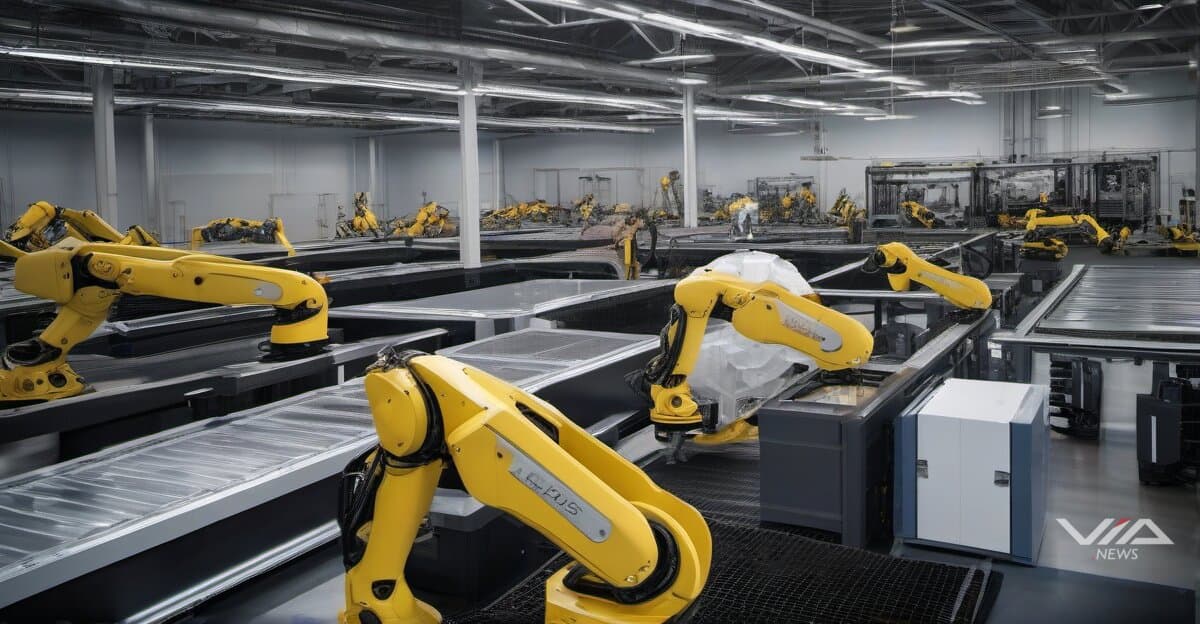
AI-powered warehouse robotics systems have crossed the 98% accuracy threshold as the industry enters commercial deployment phase across autonomous vehicles, manufacturing, and logistics sectors.
Autonomous vehicle manufacturers have confirmed 2026-2027 production timelines, marking the transition from pilot programs to mass manufacturing. The convergence of AI breakthroughs with AI-RAN 5G telecom infrastructure enables real-time processing for navigation and object recognition systems.
Warehouse automation represents the most mature deployment category. Systems using computer vision and machine learning now handle inventory management, order fulfillment, and quality control with minimal human intervention. The 98%+ accuracy rates match or exceed human performance in repetitive tasks while operating 24/7.
Defense contractors and industrial manufacturers have formed partnerships to deploy physical AI in production facilities. These systems integrate sensors, actuators, and decision-making algorithms to perform complex assembly tasks previously requiring human dexterity and judgment.
Regulatory approvals are expanding access to assistive robotics in healthcare and service industries. Agencies have cleared devices for patient mobility assistance, surgical support, and rehabilitation therapy after validation studies demonstrated safety profiles comparable to existing medical equipment.
The commercial acceleration follows years of laboratory development. Companies can now source standardized components—vision systems, manipulator arms, mobility platforms—and integrate them with custom AI models trained on industry-specific datasets. This modular approach reduces deployment costs and development timelines.
Manufacturing automation benefits from robots that adapt to production line changes without extensive reprogramming. Machine learning models learn new assembly patterns from human demonstrations, then optimize the process through repetition. Factories report 30-40% efficiency gains after full integration.
Five sectors dominate current deployments: logistics fulfillment centers, automotive manufacturing, warehouse inventory management, food processing facilities, and electronics assembly plants. Each has moved beyond proof-of-concept to multi-site implementations with documented ROI.
The shift from research to commercialization indicates the technology has matured beyond academic curiosity into reliable business infrastructure capable of replacing or augmenting human labor at scale.