
Wednesday, September 2, 2026

Industrial Robot Installations Hit 55,000 Units Annually as Battery Partnerships Reshape Mobile Automation

Industrial robot installations in the Americas exceeded 55,000 units for three consecutive years, while UK deployments surged 51% in September 2024. Battery technology partnerships between automakers and electronics manufacturers now drive mobile robot adoption as power systems become the critical bottleneck in autonomous manufacturing.

Industrial Robot Installations Hit 55,000 Units Annually as Battery Partnerships Reshape Mobile Automation
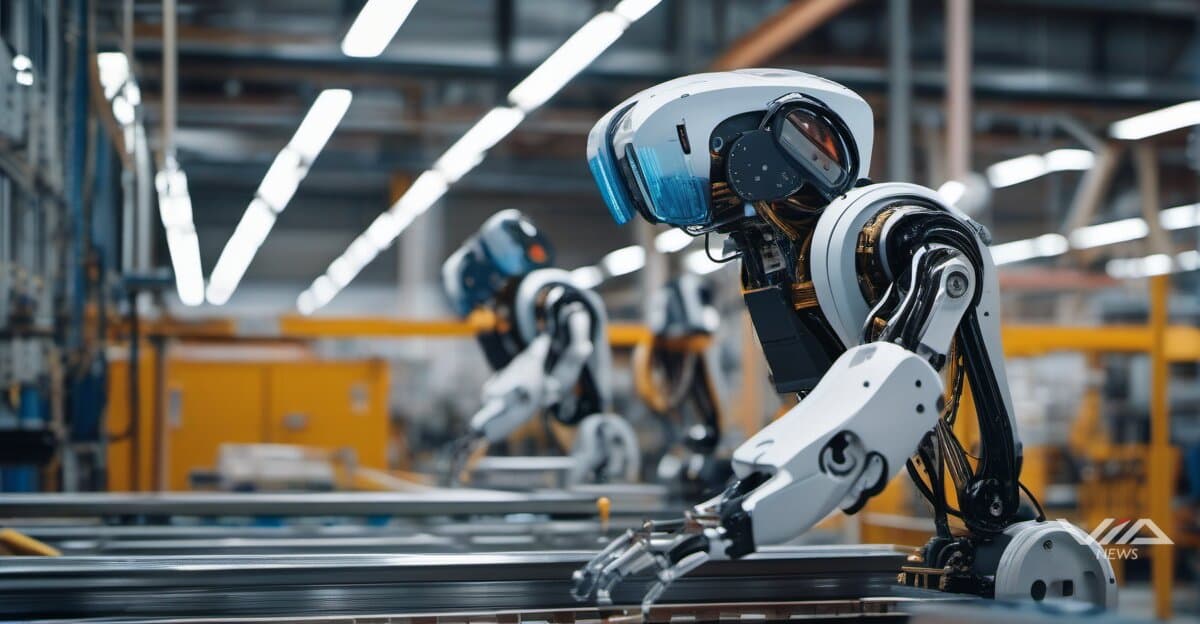
Image generated by AI for illustrative purposes. Not actual footage or photography from the reported events.
Loading stream...

Industrial robot installations in the Americas surpassed 55,000 units annually for the third straight year, sustaining momentum in manufacturing automation despite global economic uncertainty. The UK market jumped 51% in September 2024 compared to the prior year, signaling accelerated adoption beyond traditional robotics strongholds.

Battery technology emerged as the constraint limiting mobile robot deployment. Hyundai, Kia, and Samsung SDI formed a collaboration to develop specialized power systems for industrial robots. Electrovaya announced a battery system launch scheduled for July 2025 targeting autonomous manufacturing equipment.

The industrial robot battery market report released January 28, 2026 identified energy density and charge cycle durability as the primary technical barriers. Mobile robots require 8-12 hour operational windows between charging, double the capacity of current lithium-ion packs designed for consumer electronics.

Automaker involvement signals battery economics reaching viability for industrial applications. Samsung SDI produces battery cells for electric vehicles at $100-120 per kilowatt-hour. Adapting these systems for stationary and mobile robots could slash power costs by 40% compared to specialized industrial battery suppliers.

The correlation between battery partnerships and robot deployment suggests mobile automation depends on energy infrastructure more than mechanical innovation. Autonomous mobile robots (AMRs) represent 15-20% of new industrial robot installations, up from 8% in 2022. Fleet operations require coordinated charging stations and battery swapping protocols that mirror electric vehicle infrastructure.

Regional installation patterns show concentration in automotive and electronics manufacturing. The Americas maintain above-55,000 unit annual installations driven by reshoring initiatives and labor cost pressures. UK growth reflects manufacturing digitization policies and investment incentives for automation.

Quarterly 2026 installation data will test whether battery technology partnerships accelerate mobile robot adoption rates. Current deployment growth of 15-18% annually could double if battery costs drop below $80 per kilowatt-hour and energy density increases 25-30%. The hypothesis predicts measurable correlation between announced battery partnerships and subsequent AMR installation volumes within 12-18 months.

What we know · the intelligence behind this page
Live from the substrate
What we're seeing
AI Capital Surge: Late-August 2026 Funding Wave Spans Fintech, Enterprise Agents, and Robotics
A dense cluster of funding rounds landing on 2026-08-28 — from identity/fraud fintech player Socure ($156M plus its acquisition of Fravity) to enterprise AI agent startups (Instinct, Generalist AI, Owner), model infrastructure (Stability AI, Emerald AI), and autonomous logistics/aerospace (Gatik, Regent Craft) — signals investors are rotating aggressively into AI-native companies with demonstrable ROI, especially in financial risk/compliance and back-office automation. Parallel signals (Multiverse Computing's compression benchmarks cutting inference cost/latency, and Arkestro/CloneOps.ai publishing hard savings and labor-displacement figures) suggest the funding is chasing efficiency and measurable economic impact rather than pure model scale.
Our read on the data ›
Signals we're tracking
Satellite-Terrestrial Network Integration Acceleration
Increased investment and launches in hybrid satellite-cellular networks across telecom industry; competitive responses from other carriers; regulatory activity around satellite spectrum; expansion of emergency/rural connectivity use cases
Patterns we're watching ›
Where sources disagree
ING Group
Both facts record the same metric (shares_outstanding) for ING Group at the identical observation date (2025-12-31). FACT A states 2,902,437,688 shares; FACT B states 2,902 million shares (2,902,000,000). The difference is 437,688 shares (~0.015%). This is a genuine value conflict, though the discrepancy appears to result from FACT B rounding to the nearest million while FACT A provides the precise count.
We flag conflicts openly ›
Recently verified
Checked against the original source
4,980
facts traced to their source — and we flag the ones that don't hold up.
101 entities tracked4,980 facts checked against source5,267 source documents archived
Query this data → isubstrate.com